FOMO Investing: The Science Behind Why Gen Z Panic-Buys Meme Stocks
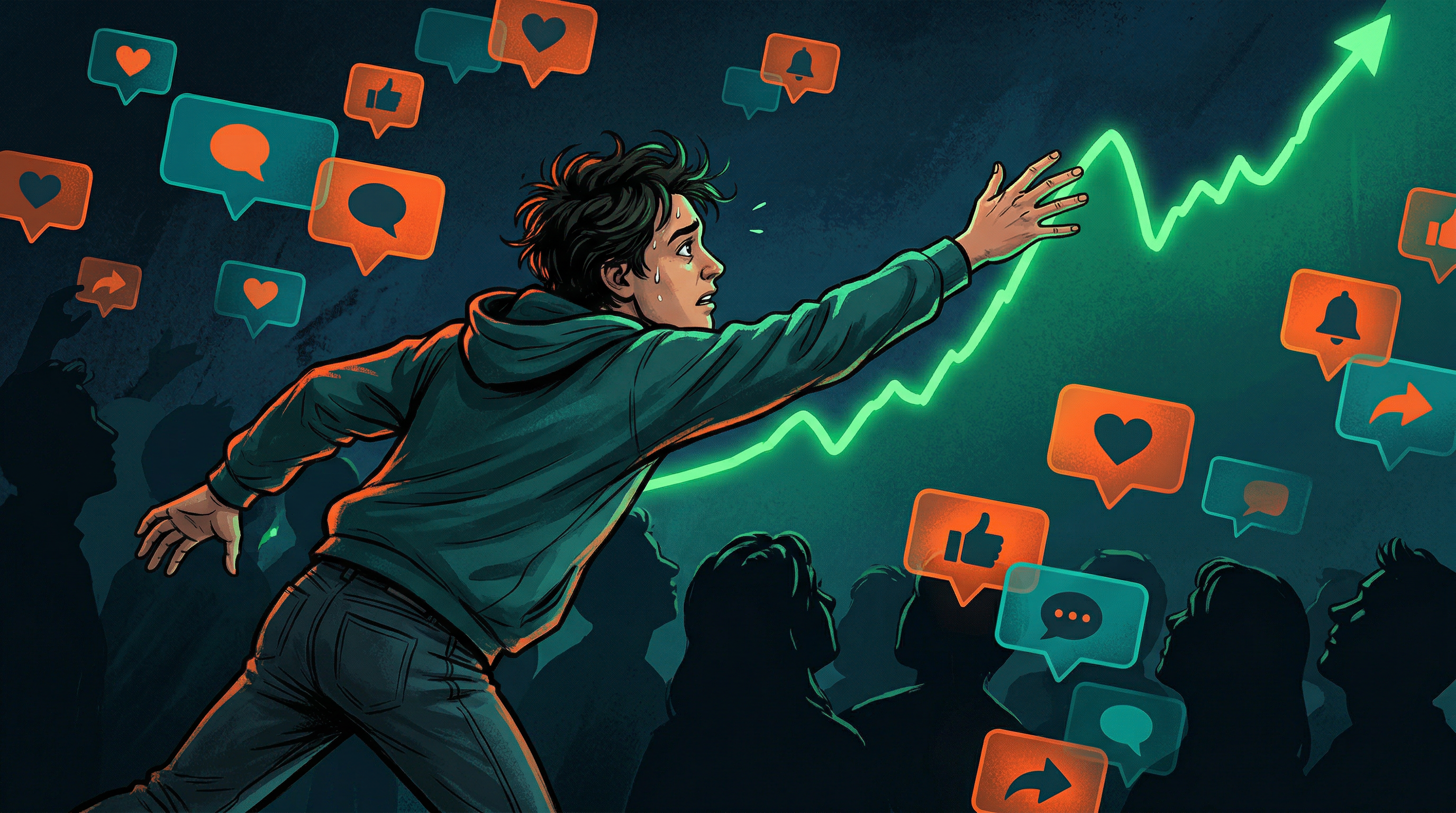
In January 2021, GameStop went from $20 to $483 in two weeks. Thousands of young investors — many making their first-ever trades — piled in not because of fundamental analysis, but because of something far more primal: the fear of missing out.
FOMO Is a Neurological Event
When you see others profiting from a trade you're not in, your brain's anterior insula activates — the same region associated with disgust and social pain. fMRI studies show that financial FOMO triggers a stress response nearly identical to social exclusion. Your brain literally processes missing a trade the same way it processes being left out of a group.
For Gen Z — a generation that has grown up with real-time social media feeds — this effect is amplified exponentially. Trading gains are displayed on TikTok and Twitter with the same dopamine-triggering mechanics as likes and follows.
The Social Proof Cascade
Social proof is one of Cialdini's six principles of influence, and it's turbocharged in online trading communities. When 50 people in your Discord server are buying the same stock, the psychological pressure to conform is enormous. Research from MIT's Sloan School found that traders who participate in online communities make 60% more impulsive trades than those who trade in isolation.
The most successful traders combine knowledge with the right tools. Focus on understanding the fundamentals before committing real capital.
"In the age of social media, every market bubble is a social contagion. The virus isn't greed — it's the fear of being the only one not getting rich." — Professor Andrew Lo, MIT
Why Gen Z Is Particularly Vulnerable
Three factors converge:
- Constant social comparison: Instagram and TikTok normalize unrealistic gains, creating a distorted benchmark for "normal" returns.
- Gamified trading apps: Confetti animations, push notifications about trending stocks, and simplified interfaces reduce the friction between impulse and action.
- Compressed time horizons: A generation accustomed to instant gratification finds it psychologically difficult to adopt long-term strategies.
Building FOMO Resilience
The antidote isn't avoiding social media — it's building awareness. Traders who can name the emotion ("I'm feeling FOMO") are 40% less likely to act on it impulsively. Other evidence-based strategies include:
- Implementing a mandatory 24-hour waiting period before entering any trade sourced from social media
- Keeping a decision journal that records the emotional state at the time of each trade
- Setting strict daily trading limits that can't be overridden in the moment
Build Better Trading Habits
Traderise uses behavioral science to help you trade smarter — not just faster.
Try Traderise FreeReady to Start Trading?
Join thousands of traders using Traderise — the platform built for the next generation.
Try Traderise Free →