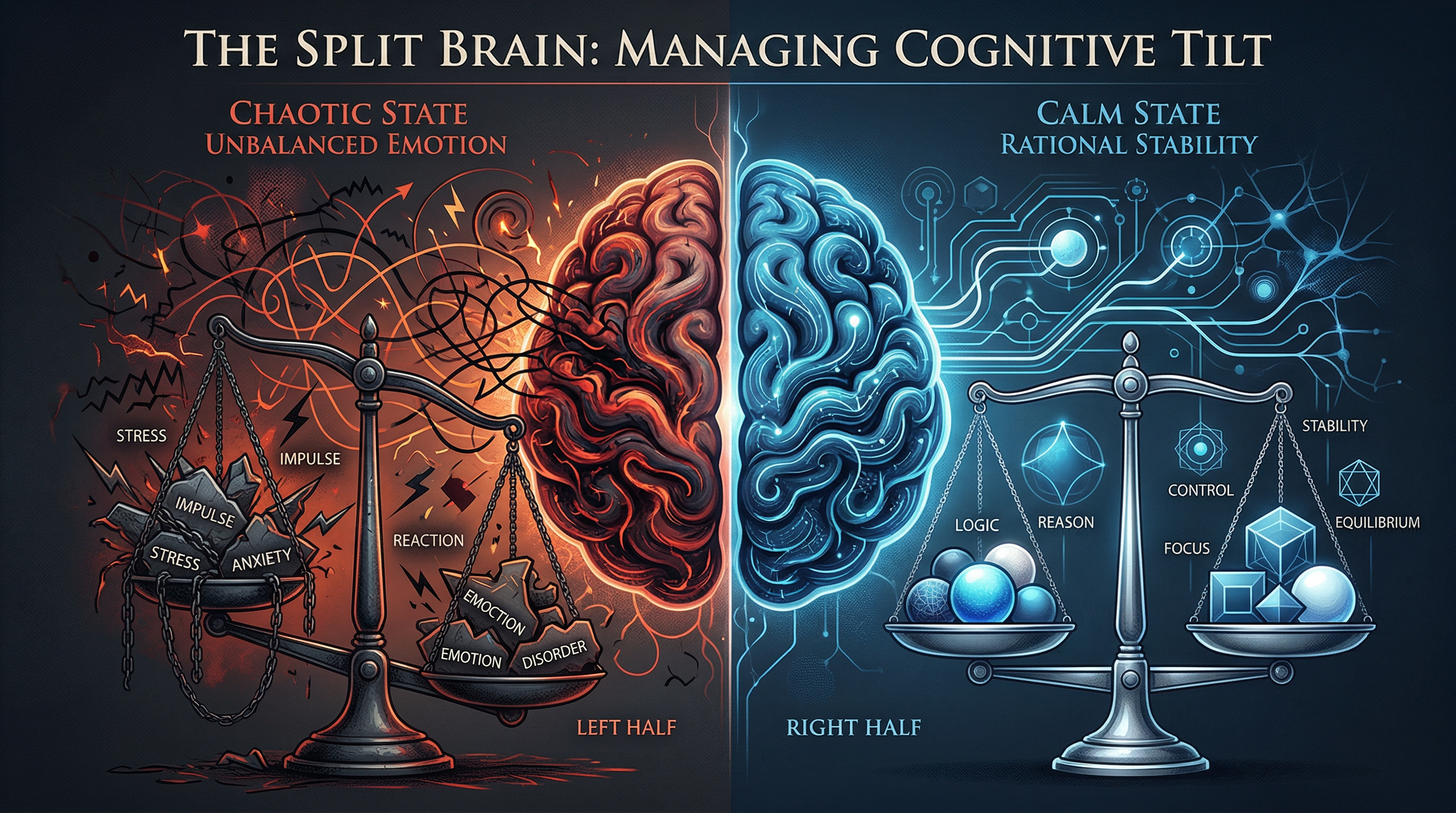
The term "tilt" comes from poker — it describes the emotional state where a player, after a bad beat, begins making increasingly irrational decisions driven by frustration rather than strategic thinking. In poker, tilt is so well-documented and so devastating to player outcomes that entire books and coaching programs are dedicated to it. In trading, the phenomenon is identical — just less commonly named. A 2025 study analyzing high-frequency trading data found that after three consecutive losses, 67% of retail traders showed statistically significant increases in position size, frequency of trading, and strategy deviation — classic tilt signatures. And the study found that tilt-driven sessions accounted for a disproportionate 43% of total annual losses despite representing only 19% of total sessions. If you've ever "traded your way out of a hole" and made it worse, you know exactly what tilt is. Here's how professionals stop it from destroying them.
The Neuroscience of Tilt: Why Bad Losses Make the Next Decision Worse
Tilt is a neurological state, not a character weakness. Research by Antoine Bechara and Antonio Damasio at USC using the Iowa Gambling Task showed that emotional states from recent decisions contaminate subsequent decisions through what Damasio calls "somatic markers" — bodily states associated with past outcomes that bias future choices. After a painful loss, the somatic marker of that loss creates a negative valence that pushes subsequent decisions toward risk-seeking (trying to recover) or risk aversion (fearing another loss) — neither of which represents rational risk assessment.
A 2024 neuroimaging study of poker players in tilt states found hyperactivation of the amygdala and reduced activation of the ventrolateral prefrontal cortex — exactly the pattern seen in impaired decision-making states. Tilt isn't "playing badly." It is a measurable change in brain function that impairs the neural systems responsible for good decisions.
5 Behavioral Signatures of Trading Tilt
- Increasing position size after losses without changing the analysis
- Trading setups that don't meet your criteria ("I just know this one will work")
- Dramatically increasing trading frequency to "make back" losses quickly
- Ignoring or overriding stop-losses
- Staying in the market past your normal session time trying to recover
The most dangerous thing about tilt is that it feels like justified confidence. When you're tilting, the decision to take an oversized revenge trade doesn't feel impulsive — it feels obvious. "This setup is perfect, and I need to make this back." This subjective sense of clarity is the hallmark of tilt: impaired judgment feels like enhanced judgment. Traderise's daily loss limits enforce a circuit breaker that interrupts tilt before it escalates — removing the in-the-moment decision from an impaired decision-maker.
How Professional Traders Recognize and Stop Tilt
Research interviews with 23 consistently profitable professional traders (proprietary, hedge fund, and independent) conducted in 2024 identified several common tilt-management practices that distinguished them from less consistent performers:
1. The Pre-Session Tilt Inventory
Before every session, professional traders in the research sample rated their emotional state on several dimensions: frustration level, money-mindedness (preoccupied with P&L rather than process), and recency of emotionally significant losses. Those who rated high on tilt indicators either reduced their risk parameters for the session or skipped trading entirely. This pre-session tilt inventory prevents the most predictable tilt episodes — those following clearly identifiable emotional triggers — from ever making it into the market. Traderise's pre-trade journal includes emotional state fields specifically for this purpose.
2. The "Three Strikes" Rule
The most commonly cited tilt prevention rule across the professionals interviewed: three consecutive losses triggers an automatic session break of 30-60 minutes minimum. Not a guideline. A hard rule. The rule exists because three consecutive losses is the empirically identified threshold where tilt probability increases sharply in the research data. The break allows cortisol and adrenaline to clear, prefrontal function to restore, and the worst of the emotional contamination to dissipate before the next decision is made. Traderise's session tracking can alert you when you've hit this threshold.
3. Physical Tilt Interrupts
Physical movement is the fastest biological intervention for tilt states. Standing up and leaving the trading environment — even for 5-10 minutes — produces measurable stress hormone reduction and prefrontal reengagement. Professional traders in the research sample described specific physical interrupts: walking outside, going to the gym, doing push-ups, splashing cold water on their face. The specific activity is less important than the combination of physical movement and environmental change that disrupts the neurological pattern maintaining tilt.
Trade With Your Brain, Not Against It
Traderise includes built-in trading journals, risk controls, and psychology-aware features designed to help you make better decisions.
Try Traderise Free4. Post-Loss Journaling Before Re-entry
Several traders in the research sample used a mandatory post-loss journaling protocol before re-entering the market after a significant loss: write down exactly what happened, evaluate whether the loss was due to process failure or random variance, identify any emotional state that might be contaminating your current judgment, and make a conscious decision to proceed (with a note about the decision and its rationale) or pause. This journaling creates a forced System 2 activation — the deliberate writing process engages the analytical brain and provides a check on tilt-state impulsivity. Use Traderise's structured loss review prompts for this purpose.
5. Financial Tilt Limits: The Non-Negotiable Circuit Breaker
Without exception, the professional traders in the research sample had pre-committed daily loss limits that ended their trading session when reached — regardless of their subjective state or conviction about recovery opportunities. The reason: by the time a trader reaches the daily loss limit, the conditions for tilt are maximally present. Removing the decision to continue trading from the tilted trader's hands prevents the worst tilt escalations. A 2025 analysis of proprietary trading firms found that firms with automated daily loss limits had 68% lower maximum monthly drawdowns than those relying on trader discretion to stop.
The Long-Term Practice: Building Tilt Resistance
Tilt resistance is a trainable psychological capacity, not a fixed personality trait. Research on cognitive-behavioral approaches to tilt in both poker and trading contexts shows that deliberate practice of tilt interruption protocols, combined with honest post-tilt analysis (examining what triggered tilt, what it felt like, and how it affected decisions), produces measurable improvements in tilt resistance over 3-6 months of consistent application. The path to tilt resistance is not willpower — it's practice of the specific skills needed to recognize tilt early, interrupt it effectively, and re-engage only when the neurological state supports quality decisions. Platforms like Traderise that provide the structural tools — automatic loss limits, emotional state logging, mandatory review prompts — give traders the scaffolding this practice requires.
Break the Tilt Cycle Before It Breaks Your Account
Traderise's automated daily loss limits, emotional logging, and loss review prompts give you the exact tools professional traders use to manage tilt systematically.
Try Traderise Free