Revenge Trading: Why You Keep Doubling Down After a Loss (And How to Stop)
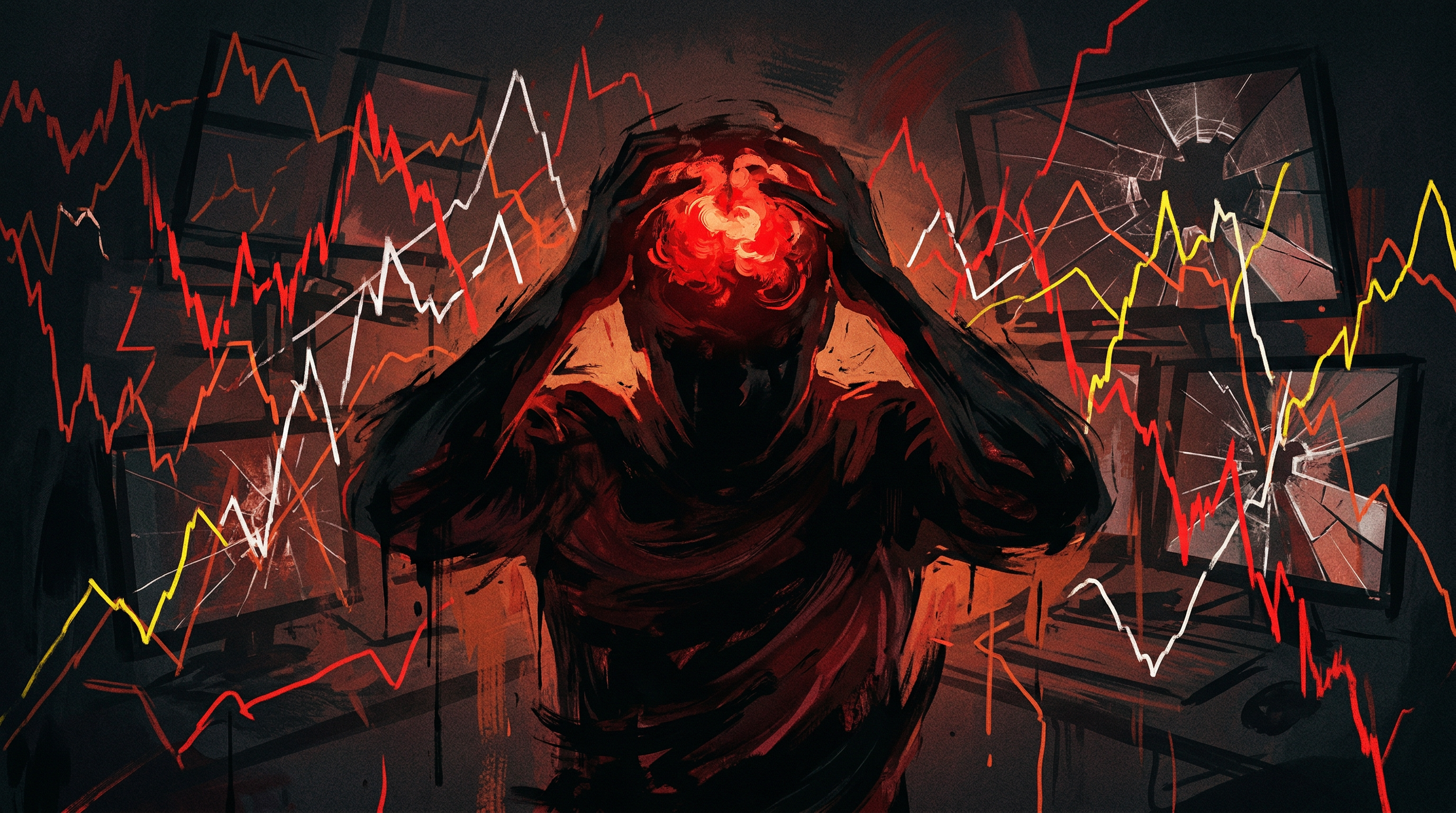
You lost $800 on a trade that should have worked. The setup was clean. Your thesis was sound. And yet the market moved against you — hard and fast. You close the position, stare at the red number in your P&L, and feel something rising in your chest that has nothing to do with rational analysis. It's anger. It's indignation. It's the overwhelming urge to get that money back right now.
So you jump back in. Bigger size this time. Less analysis. No waiting period. And within an hour, you've turned an $800 loss into a $2,400 hole. Welcome to revenge trading — one of the most psychologically predictable and financially destructive patterns in all of retail trading.
What Revenge Trading Actually Is
Revenge trading is the act of entering impulsive, emotionally driven trades immediately after a loss, with the primary motivation of recovering that loss rather than executing a well-reasoned strategy. It is not simply "trading after a loss." Experienced traders take losses constantly — that's the nature of probabilistic decision-making. Revenge trading is distinguished by its emotional signature: the trader is no longer making decisions based on edge. They are making decisions based on pain.
The term "revenge" is apt because the trader's psychological stance is adversarial. They feel wronged by the market and are attempting to punish it, reclaim what was taken, or restore a sense of control. Of course, markets are indifferent. You cannot hurt a market. You can only hurt yourself.
A 2020 study published in the Journal of Behavioral and Experimental Finance found that traders who executed trades within 10 minutes of closing a losing position had a 63% probability of that follow-up trade also being a loser — compared to a roughly 47% loss rate on trades entered under normal conditions. The speed of re-entry was a stronger predictor of negative outcomes than the size of the initial loss itself.
The Neuroscience: What's Happening Inside Your Brain
To understand why revenge trading is so compelling — and so hard to stop — you need to understand what a financial loss does to the brain at the neurological level.
The most successful traders combine knowledge with the right tools. Focus on understanding the fundamentals before committing real capital.
The Amygdala Hijack
When you take a loss, your amygdala — the brain's threat detection center — activates before your prefrontal cortex can engage in deliberate reasoning. This is the same fight-or-flight mechanism that evolved to help our ancestors escape predators, and it operates on a timescale of milliseconds. Daniel Goleman, the psychologist who popularized the concept of emotional intelligence, calls this an "amygdala hijack": the emotional brain overrides the rational brain.
In the context of trading, the amygdala doesn't distinguish between "a lion is chasing you" and "you just lost $800 on NVDA calls." Both register as threats. Both trigger the same cascade of cortisol and adrenaline. Both produce the same narrowing of attention, the same urgency to act, the same suppression of long-term thinking.
Dopaminergic Prediction Errors
The neuroscience goes deeper than fight-or-flight. Research by Wolfram Schultz at the University of Cambridge has demonstrated that dopamine neurons encode prediction errors — the gap between what you expected and what actually happened. When a trade that you expected to win instead loses, your dopamine system fires a strong negative prediction error signal. This creates an aversive state that the brain is desperate to resolve.
The fastest way to resolve a negative prediction error? Seek a new reward. Enter a new trade. The possibility of winning — not the actual win itself — triggers a dopamine release that temporarily alleviates the aversive state. This is the same neurological mechanism that drives problem gambling, and it explains why revenge traders often report feeling a moment of relief when they enter the next trade, even before it resolves.
The Cortisol Feedback Loop
John Coates, a former Wall Street trader turned neuroscientist at Cambridge, conducted pioneering research on hormones and trading behavior. In his landmark 2008 study published in the Proceedings of the National Academy of Sciences, Coates found that traders' cortisol levels rose 68% on days when their P&L volatility was high. Critically, elevated cortisol didn't just accompany losses — it changed subsequent decision-making. High-cortisol traders became significantly more risk-averse in their initial response, but when forced to act (by market conditions or internal pressure), they swung to the opposite extreme: reckless, oversized risk-taking.
This is the cortisol feedback loop that powers revenge trading. The initial loss raises cortisol. High cortisol produces anxiety and a sense of being "behind." The anxiety demands resolution. The trader seeks resolution through action — typically, aggressive action — which usually produces another loss, which raises cortisol further. The spiral tightens.
Prospect Theory: The Mathematical Foundation
The most rigorous explanation for revenge trading comes from Daniel Kahneman and Amos Tversky's prospect theory, the Nobel Prize-winning framework that describes how humans actually make decisions under uncertainty (as opposed to how classical economics assumed they did).
Prospect theory makes two claims that are directly relevant to revenge trading:
1. Loss Aversion — Losses Loom Larger Than Gains
Kahneman and Tversky's original 1979 research demonstrated that the psychological pain of losing a given amount is approximately 2 to 2.5 times more intense than the pleasure of gaining the same amount. This asymmetry is hardwired. It persists across cultures, income levels, and levels of trading experience. It means that an $800 loss doesn't just feel bad — it feels roughly as bad as missing out on a $1,600-$2,000 gain would feel good.
This disproportionate pain is the emotional fuel for revenge trading. The loss feels so aversive, so wrong, that the trader becomes willing to accept irrational levels of risk in order to make it disappear.
2. Risk-Seeking in the Domain of Losses
This is the less widely known — but more directly relevant — component of prospect theory. Kahneman and Tversky showed that while people are typically risk-averse when facing gains (they prefer a certain $500 over a 50/50 chance of $1,000), they become risk-seeking when facing losses. Given a choice between a certain loss of $500 and a 50/50 chance of losing $1,000 or nothing, most people choose the gamble.
Apply this to trading: after an $800 loss, the trader faces a choice. Option A: accept the loss, walk away, and start fresh tomorrow. Option B: enter a high-risk trade that could either recover the $800 or double the loss to $1,600. Prospect theory predicts — and empirical data confirms — that the majority of traders will choose Option B. Not because it's rational. Because the human brain, when it's sitting in the loss domain of the prospect theory value function, is literally wired to prefer gambles over certain losses.
Richard Thaler, the behavioral economist who won the 2017 Nobel Prize, extended this framework with his concept of "mental accounting." Traders mentally segregate each trade into its own account. A loss in one mental account creates an urgent need to close that account at breakeven — even if the rational approach would be to evaluate each new trade on its own merits, independent of past results.
The Breakeven Effect: Why "Getting Back to Even" Becomes an Obsession
Closely related to prospect theory is what researchers call the "breakeven effect" — the intensified risk-seeking that occurs specifically when traders are near their reference point (usually their starting balance or their balance from that morning).
A 2015 study by Imas in the American Economic Review provided elegant experimental evidence. Participants who experienced paper losses (unrealized) actually became more risk-averse, but those who realized their losses (sold and locked in the loss) became dramatically more risk-seeking in subsequent decisions. The mere act of closing a losing trade — converting a paper loss into a realized loss — triggered the risk-seeking behavior characteristic of revenge trading.
This finding has an uncomfortable implication: the discipline of using stop-losses (which is generally excellent practice) can, paradoxically, trigger the revenge trading response if the trader doesn't have a system for managing post-stop-loss behavior. The stop-loss converts the paper loss into a realized loss, which activates the risk-seeking domain of prospect theory, which produces the urge to immediately re-enter the market.
The Sunk Cost Escalation
Revenge trading doesn't always present as a single impulsive trade. Often, it manifests as a slow, grinding escalation — what behavioral scientists call "escalation of commitment to a failing course of action."
Barry Staw's classic 1976 research on escalation demonstrated that once people have invested resources in a course of action, they tend to invest more resources to justify the initial investment — even when the evidence strongly suggests they should cut their losses. In trading, this looks like averaging down on a losing position, adding to a trade that has moved against you, or widening a stop-loss to avoid being stopped out.
The trader's internal logic is seductive: "I'm already down $800. If I add to my position here and it bounces even a little, I'll recover everything." The sunk cost fallacy transforms what should be a simple risk/reward calculation into a psychological hostage negotiation with yourself.
A 2018 study in the Journal of Finance by Barberis and Xiong analyzed brokerage data from over 78,000 accounts and found that the probability of a trader adding to a losing position — rather than cutting it — increased monotonically with the size of the unrealized loss. Traders were nearly three times more likely to double down on a position that was down 20% than one that was down 5%.
Who Is Most Vulnerable?
While revenge trading can afflict anyone, research has identified several factors that increase vulnerability:
- Traders with strong ego identification: If your self-worth is tied to your P&L, every loss is an identity threat, and revenge trading becomes a form of ego repair. A 2019 study in Personality and Individual Differences found that traders scoring high on narcissistic vulnerability were 2.4 times more likely to engage in revenge trading patterns.
- Newer traders: Experience doesn't eliminate revenge trading, but it does reduce its frequency. Seasoned traders have a larger sample of losses to draw on, making any single loss feel less catastrophic. Newer traders may have experienced only a handful of real losses, making each one feel disproportionately significant.
- Traders using leverage: Leverage amplifies losses, which amplifies the emotional response, which amplifies the revenge trading impulse. The 2020 ESMA study on retail CFD trading found that leveraged traders were 3.1 times more likely to increase position size after a loss than unleveraged equity traders.
- Social media-connected traders: Traders who share their P&L publicly (on Discord, Twitter, or Telegram) experience losses not just as financial events but as social status events. The added layer of public embarrassment intensifies the urge to quickly "fix" the loss.
- Traders under financial pressure: When losses threaten your ability to pay rent or meet financial obligations, the survival circuits in the brain become activated, making rational decision-making nearly impossible. This is why the first rule of trading — only trade with money you can afford to lose — is fundamentally a psychological risk management rule.
The Anatomy of a Revenge Trade: A Case Study
Consider a pattern that plays out thousands of times daily across retail trading accounts:
9:35 AM: The trader enters a long position on SPY based on a pre-market thesis about a bullish gap-fill pattern. Position size: $5,000. Stop-loss: 1.5% below entry.
9:52 AM: An unexpected economic data release causes a sudden drop. The stop-loss triggers. Loss: $75. The trader feels a flush of frustration but recognizes it as a normal loss within their system's parameters.
9:55 AM: The trader notices that SPY is continuing to drop. A thought forms: "I was right about the direction, just wrong about the timing. If I short now, I can recover that $75 and then some." This thought feels like analysis but is actually the amygdala generating a post-hoc rationalization for an emotionally driven impulse.
9:57 AM: The trader enters a short position. Position size: $8,000 (60% larger than their standard size — an unconscious escalation driven by the need to recover quickly). No stop-loss set — "I'll manage it manually."
10:15 AM: SPY reverses and begins climbing. The trader's short is now underwater by $160. The original loss of $75 feels trivial compared to this new exposure. The trader holds, telling themselves "it'll come back down."
10:45 AM: The short is now down $340. The trader adds to the position. "Average up the short. When it drops, I'll make everything back."
11:30 AM: The total loss exceeds $700. The trader finally closes the position, now sitting in a hole nearly 10 times larger than the original $75 loss that started the cascade.
Every element of this cascade is psychologically predictable. The speed of re-entry. The increased position size. The absence of a stop-loss. The averaging into a loser. The delayed exit. This isn't a failure of intelligence or knowledge. It's a failure of emotional regulation under the specific neurochemical conditions produced by financial loss.
How to Stop Revenge Trading: Evidence-Based Strategies
Understanding the science is necessary but not sufficient. You cannot simply "know about" revenge trading and expect to stop doing it — just as knowing about loss aversion doesn't make you loss-neutral. The strategies that actually work target the behavior at multiple levels: neurological, cognitive, and structural.
Strategy 1: The Mandatory Cooling-Off Period
The single most effective intervention is also the simplest: after any loss that exceeds a predefined threshold, you are not allowed to trade for a fixed period. The threshold and the period should be defined in advance, when you're calm and rational — not in the moment.
Why does this work? Because it directly addresses the temporal mismatch at the heart of revenge trading. The amygdala hijack peaks within 2-5 minutes of the loss and gradually subsides over 20-90 minutes as the prefrontal cortex reasserts control. A 30-minute mandatory cooling-off period ensures that your next trading decision is made by your prefrontal cortex, not your amygdala.
Brett Steenbarger, a clinical psychologist who has worked with professional trading firms for decades, recommends what he calls the "two-hour rule": after a loss exceeding 1% of your account, you cannot enter a new trade for two hours. His data from proprietary trading firms shows that this single rule reduced revenge trading incidents by approximately 82%.
Strategy 2: The Pre-Commitment Device
Behavioral economics has extensively studied "pre-commitment devices" — mechanisms that restrict your future choices before you're in a state where poor choices are likely. Odysseus tying himself to the mast is the canonical example. In trading, pre-commitment devices include:
- Daily loss limits: Define a maximum daily loss (e.g., 2% of account equity). Once hit, trading is done for the day. No exceptions. Write this number down. Tell your trading partner or accountability buddy.
- Maximum trade frequency limits: No more than X trades per day. This prevents the rapid-fire re-entry pattern characteristic of revenge trading.
- Position size locks: Your maximum position size is defined before the trading day begins. It cannot be increased during the day, regardless of P&L.
The critical insight is that these rules must be binding, not advisory. A rule that says "I should stop after losing 2%" is useless — your revenge-trading brain will immediately override it with "but this setup is too good to pass up." The rule needs to be mechanically enforced.
Platforms like Traderise include built-in guardrails — features like Smart Bracket automatically set stop-losses based on technical levels, removing emotion from the exit decision. This kind of structural enforcement is far more reliable than willpower alone, because it shifts the point of decision from the emotionally compromised present to the rational past.
Strategy 3: The Loss Journal
Cognitive behavioral therapy (CBT) research has consistently demonstrated that the act of writing about an emotional experience reduces its physiological intensity. James Pennebaker's expressive writing paradigm, replicated hundreds of times since the late 1980s, shows that writing about stressful events for even 15 minutes reduces cortisol levels and improves subsequent decision-making.
Apply this to trading: after every loss, before doing anything else, write a brief entry in a loss journal. The entry should include:
- The trade thesis and what went wrong
- Your emotional state on a 1-10 scale (1 = calm, 10 = furious)
- Whether you feel the urge to immediately re-enter
- What prospect theory predicts you'll want to do right now
- What you'll actually do instead
The fourth item is the most powerful. By explicitly naming the bias — "Prospect theory predicts that I'm now in the loss domain and will be risk-seeking" — you activate what psychologists call "cognitive defusion." You create a gap between the impulse and the action. You transform an automatic emotional response into an observed psychological event. You can't stop the feeling, but you can stop the feeling from driving the behavior.
Strategy 4: Physiological Regulation
Because revenge trading is partly a physiological event (elevated cortisol, activated amygdala, narrowed attention), physiological interventions can be surprisingly effective:
- Box breathing (4-4-4-4): Inhale for 4 seconds, hold for 4 seconds, exhale for 4 seconds, hold for 4 seconds. Four cycles. This activates the parasympathetic nervous system and directly counteracts the cortisol spike. Navy SEALs use this technique under combat stress — it works for trading stress too.
- Physical movement: Walk away from the screen. Literally. A 10-minute walk reduces amygdala activation more effectively than any cognitive technique. The physical act of leaving the trading environment breaks the stimulus-response loop.
- Cold water exposure: Splash cold water on your face or hold a cold object. This triggers the mammalian dive reflex, which rapidly lowers heart rate and shifts the nervous system from sympathetic (fight/flight) to parasympathetic (rest/digest). It sounds primitive because it is — and it works.
Strategy 5: Reframe the Reference Point
Thaler's mental accounting research suggests that much of revenge trading's power comes from narrow framing — evaluating each trade (or each trading day) as a separate mental account that "needs" to be closed at breakeven. The antidote is to deliberately widen the frame.
Instead of thinking "I'm down $800 today and need to get it back," reframe to: "Over the last 60 trading days, I'm up $4,200. Today is a -$800 day. My system has a 58% win rate and a 1.3 risk/reward ratio. An $800 loss is a statistically normal event within this system."
This reframing isn't denial — it's accuracy. The revenge trading impulse is fueled by a distorted, narrowly-framed perception of reality. Widening the frame restores perspective and reduces the emotional urgency to act.
Strategy 6: The "Would I Enter This Trade Fresh?" Test
Before entering any trade after a loss, ask one question: "If I had no open positions and no recent losses, would I enter this exact trade, at this exact size, right now?"
This question strips away the loss context and forces you to evaluate the trade on its own merits. If the answer is "yes" — if the setup genuinely meets all your criteria, at your standard position size — then it's not a revenge trade. Enter it. But if the answer involves any reference to your prior loss ("I need to recover..."), any increase in position size ("just this once..."), or any relaxation of your entry criteria ("it's close enough..."), then it's a revenge trade. Walk away.
The Deeper Pattern: Revenge Trading as Avoidance
At its deepest level, revenge trading is a form of experiential avoidance — the attempt to escape an unpleasant internal state (the pain of loss) through external action (a new trade). Acceptance and Commitment Therapy (ACT), a third-wave cognitive behavioral approach, frames the problem this way: the issue isn't the loss, and it isn't even the pain of the loss. The issue is the unwillingness to sit with the pain.
Every revenge trade is, at its core, an attempt to make a feeling go away. And it never works — because even if the revenge trade is profitable, it reinforces the pattern. It teaches the brain that the correct response to loss-pain is impulsive action, guaranteeing that the cycle will repeat the next time a loss occurs.
The traders who ultimately break free from revenge trading are the ones who learn to tolerate the discomfort of a loss without acting on it. Not to enjoy it. Not to be indifferent to it. Simply to let it exist without allowing it to drive behavior. This is, in a sense, the central skill of professional trading: the ability to feel bad and do nothing.
Building an Anti-Revenge Trading System
The most effective defense against revenge trading is not a single technique but an integrated system that addresses the behavior at every level:
- Prevention: Pre-commitment devices (daily loss limits, maximum trade counts, fixed position sizes) that mechanically prevent the behavior before it starts.
- Detection: A real-time self-monitoring checklist. After every loss, run through a 30-second emotional inventory before doing anything else.
- Interruption: Mandatory cooling-off periods and physiological regulation techniques that break the stimulus-response chain.
- Processing: Loss journaling and cognitive defusion to reduce the emotional charge of the loss.
- Reframing: Wide-frame thinking that places the loss in the context of your long-term system performance.
- Review: Weekly review of all post-loss trades to identify patterns. Are your losses clustered in time? Are your worst trades always within 15 minutes of another loss? Data makes invisible patterns visible.
No single element of this system is sufficient on its own. But together, they create what behavioral scientists call a "choice architecture" that makes revenge trading harder and rational decision-making easier. You're not relying on willpower — you're redesigning the decision environment so that willpower is rarely needed.
The Paradox of Acceptance
Here is the uncomfortable truth that sits at the end of all this research: the traders who are most successful at stopping revenge trading are the ones who have made peace with losing. Not because they enjoy it, but because they understand — deeply, experientially, not just intellectually — that losses are not aberrations to be corrected. They are the cost of doing business in a probabilistic domain.
Mark Douglas, whose book Trading in the Zone remains the most influential work on trading psychology, articulated it clearly: "The best traders have evolved to the point where they believe, without a shred of doubt or internal conflict, that anything can happen." When you truly internalize this — when "anything can happen" stops being a platitude and becomes a lived belief — the emotional sting of any individual loss diminishes. And with it, the revenge trading impulse fades.
It doesn't disappear. The amygdala will still fire. Cortisol will still rise. The urge will still appear. But between the urge and the action, there will be a space. And in that space, you'll have a choice. That space is the entire difference between a revenge trader and a professional.
Build Better Trading Habits
Traderise uses behavioral science to help you trade smarter — not just faster.
Try Traderise FreeReady to Start Trading?
Join thousands of traders using Traderise — the platform built for the next generation.
Try Traderise Free →