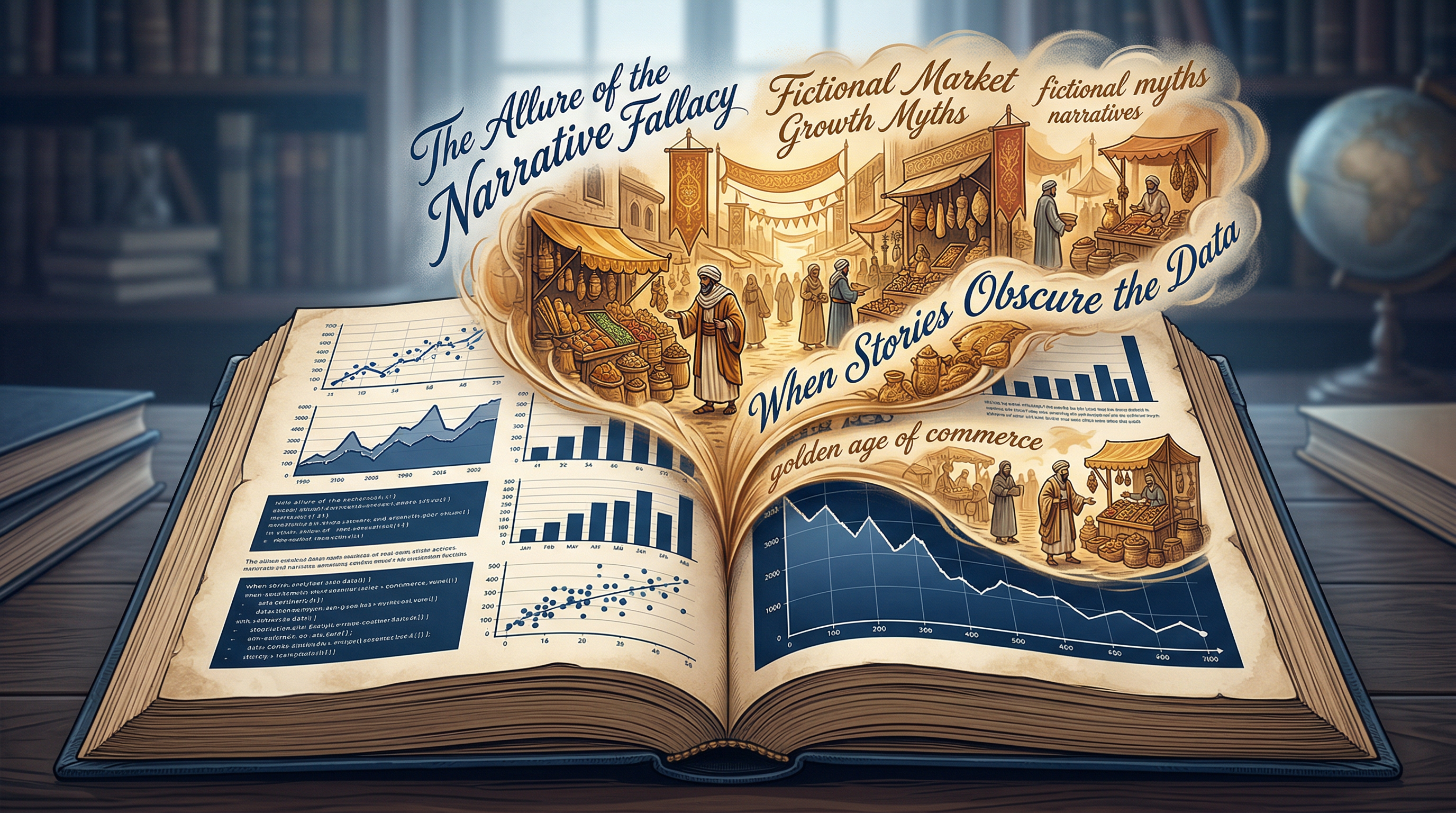
"AI is going to change everything." "The Fed has lost control of inflation." "China's real estate crisis will trigger a global recession." "This company is the next Amazon." These aren't market analysis statements. They're stories. And markets don't run on data alone — they run on narratives. The most dangerous thing about market narratives isn't that they're always wrong. It's that they're often right enough, long enough, to build enormous confidence in their completeness — and then catastrophically wrong at exactly the moment you're most exposed to them. Nassim Nicholas Taleb coined the term "Narrative Fallacy" in The Black Swan to describe humanity's irresistible tendency to impose stories on random or complex events. In markets, this tendency may be the single greatest source of investor overconfidence — and loss.
The Neuroscience of Story: Why Your Brain Prefers Narrative to Data
Human brains are narrative-processing machines. Research in cognitive neuroscience shows that information presented in narrative form activates significantly more brain regions — including those associated with sensory processing, emotion, and memory — than information presented as abstract data. Stories are more memorable, more persuasive, and more emotionally engaging than statistics, almost regardless of whether the narrative is accurate. This is not a character flaw. It's a feature of how the brain stores and retrieves information efficiently.
But in financial markets, the preference for narrative over data produces systematic errors. A compelling story about why a stock should go up is more persuasive than equally clear statistical evidence of mean reversion. A coherent macro narrative about why interest rates will stay high is more emotionally gripping than a probability distribution of Fed outcomes. The narrative captures the mind. The data stays on the page.
4 Types of Narrative Fallacy in Markets
- Hindsight narratives: "Of course the market crashed — the warning signs were obvious" (they weren't obvious in real time)
- Causation stories: "Stocks rose today because of strong jobs data" (correlation, not proven causation)
- Company fate narratives: "This company is the next Amazon/Netflix/Tesla" (pattern-matching without statistical rigor)
- Macro certainty stories: Confident predictions about economic outcomes that are genuinely uncertain
The most dangerous trade you can make is one where you're in love with the story. When the narrative is compelling enough, contradicting data gets dismissed as "noise" and the narrative becomes self-sealing. Traderise's pre-trade journal includes a mandatory field for disconfirming evidence — forcing you to confront the data that challenges your narrative before you execute the trade it's built on.
The Research on Narrative's Market Impact
Nobel economist Robert Shiller, in his 2019 book Narrative Economics, documented how economic narratives — stories that spread through populations virally, like diseases — have demonstrably driven major market events including the dot-com boom, the housing bubble, and the cryptocurrency mania. A 2025 follow-up study by Shiller's research group analyzed social media narrative spread during the 2024-2025 AI bubble and found that the velocity of positive AI narratives in retail investor communities predicted buying pressure in AI stocks more reliably than any fundamental metric over the same period. Stories moved markets. Data followed.
5 Ways to Protect Yourself from Your Own Market Stories
1. Separate Narrative from Evidence
When you find yourself building a trade thesis, deliberately separate the narrative component ("this company is disrupting the industry") from the evidence component ("the gross margin expanded 4 points year-over-year, revenue grew 40%, and the stock is trading at a discount to peers on EV/Sales"). The trade should be based on the evidence — the narrative is just a heuristic for organizing it, not a substitute for it. Log both separately in your Traderise pre-trade journal.
2. Track Narrative Confidence Against Outcome Reality
Keep a record of your most confidently held market narratives and their eventual resolution. Most traders discover, over time, that their narrative confidence is a poor predictor of outcome accuracy. This track record directly reduces the future influence of compelling stories on your conviction level.
Trade With Your Brain, Not Against It
Traderise includes built-in trading journals, risk controls, and psychology-aware features designed to help you make better decisions.
Try Traderise Free3. Demand Falsifiability
For any investment narrative you hold, define what would make you abandon it: "I believe this company is disrupting its sector. I will reconsider this thesis if: gross margins deteriorate, revenue growth decelerates below 20%, or a well-capitalized competitor launches a directly competing product." A narrative that cannot specify conditions for falsification is not an investment thesis — it's a belief. Beliefs and trading accounts don't mix well.
4. The "What's the Counter-Narrative?" Exercise
For every market story you're trading on, articulate the counter-narrative with equal seriousness: "AI is going to change everything" → "AI adoption timelines have historically been much slower than expected; the competitive dynamics may commoditize the technology faster than current pricing implies; and we may be in a hype cycle rather than a fundamental inflection." The counter-narrative doesn't need to be your conclusion — but constructing it disciplines your thinking and reduces narrative-driven overconfidence.
5. Weight Base Rates More Than Stories
Whatever the narrative says about a stock or sector, always check the base rate: What percentage of companies in this category with these characteristics at this stage have achieved the outcome the narrative predicts? How often do "the next Amazon" narratives actually produce Amazon-like returns? Base rates are almost always more informative about probable outcomes than the narrative built around a specific case — and almost always more sobering.
The Market's Ultimate Lesson About Stories
The most valuable meta-skill in financial markets is not stock picking, not technical analysis, not macro forecasting. It's calibrated uncertainty — the ability to hold narratives lightly, update them readily, and weight evidence proportionally rather than letting compelling stories capture your conviction and your capital. The traders who survive long enough to build genuine wealth are those who learn to be consumers of stories rather than believers in them. They use narratives as organizing frameworks for complex information — and let systematic evidence, not emotional resonance, determine the size of their bets. Traderise's evidence-logging pre-trade tools are designed to keep that distinction alive and visible every time you execute a trade.
Trade the Evidence — Not the Story
Traderise's pre-trade framework forces you to separate narrative from evidence — keeping your conviction grounded in data, not the most compelling story available.
Try Traderise Free