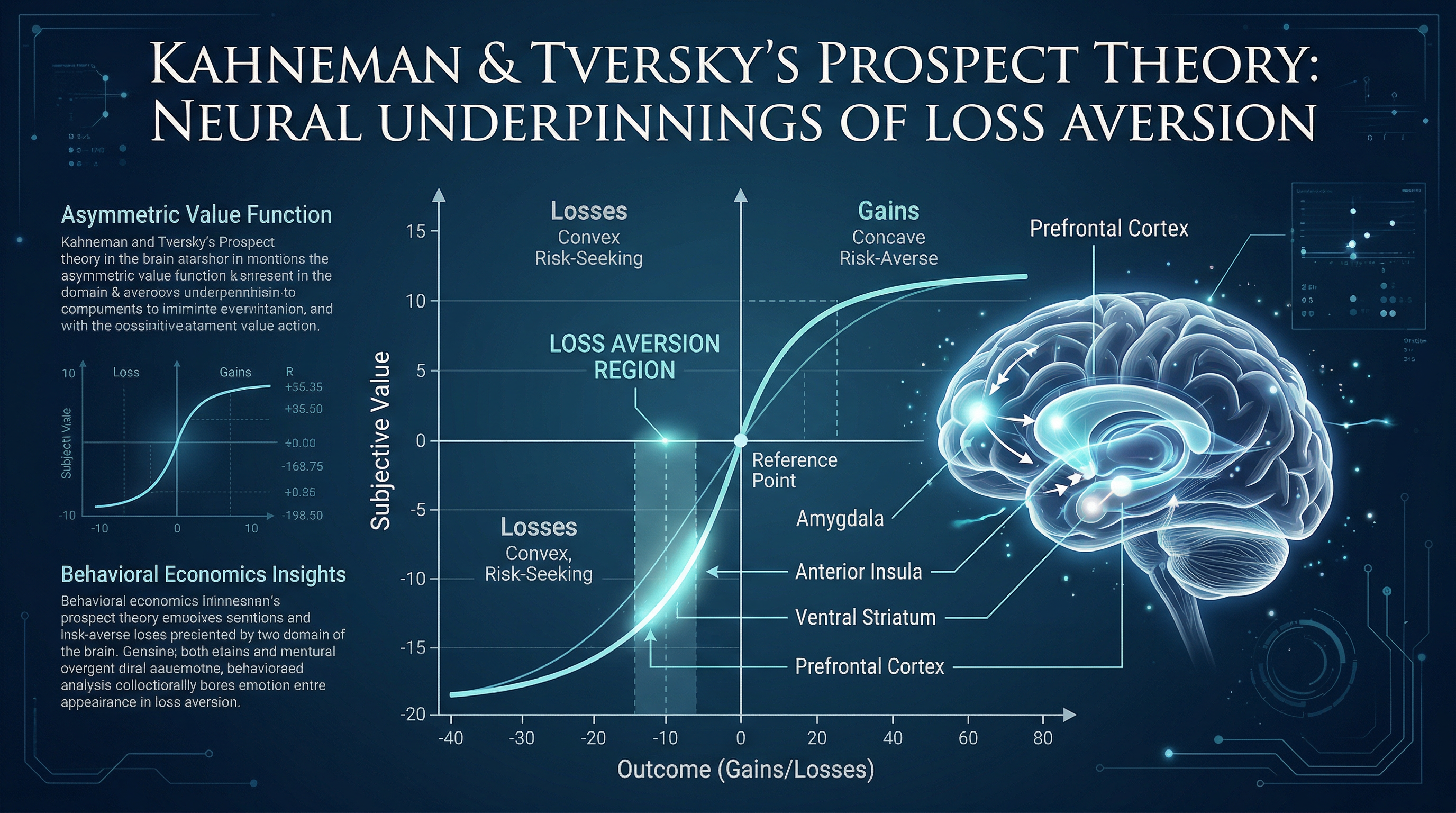
In 1979, two psychologists at Hebrew University published a paper that would eventually win a Nobel Prize and change everything we thought we knew about human decision-making. Daniel Kahneman and Amos Tversky's Prospect Theory demonstrated, with rigorous experimental precision, that human beings are not rational utility maximizers — they are loss-averse, reference-point-fixated, probability-distorting creatures whose financial decisions are systematically predictable in their irrationality. The paper, "Prospect Theory: An Analysis of Decision Under Risk," is now the most cited paper in economics. And for traders, its implications are not academic. They are the explanation for why most traders lose money even when they're right about market direction more than half the time. Your brain is not just occasionally biased. It is structurally, reliably, predictably biased against good trading decisions. Here's the proof.
Prospect Theory Explained: The 3 Core Findings That Should Change How You Trade
Finding 1: Losses Hurt 2-2.5x More Than Equivalent Gains Feel Good
Kahneman and Tversky established this through choice experiments: most people, when offered a 50/50 gamble of winning $100 or losing $100, decline — even though the expected value is zero (neither good nor bad). To accept the gamble, most people need the potential gain to be approximately $200-250 to offset the psychological pain of a potential $100 loss. This is loss aversion, and its coefficient in financial decision-making is estimated at 2.0-2.5 across hundreds of replications. You don't experience financial outcomes symmetrically. Losses hit harder. This single bias alone explains a vast proportion of irrational trading behavior.
Finding 2: The Value Function Is Concave for Gains, Convex for Losses
Kahneman and Tversky's value function describes how the subjective experience of gains and losses changes with magnitude. For gains: the jump from $0 to $100 feels much better than the jump from $900 to $1,000. For losses: the jump from $0 to -$100 feels much worse than the jump from -$900 to -$1,000. This means: as losses accumulate, each additional loss hurts progressively less — which explains why traders engage in escalating risk-taking during drawdowns. The first -$1,000 hurts more than the second -$1,000, which hurts more than the third. You literally become desensitized to losses as they accumulate, enabling reckless recovery attempts that can destroy accounts.
Finding 3: People Overweight Small Probabilities and Underweight Large Ones
Prospect theory includes a probability weighting function that demonstrates systematic distortion: people treat a 1% chance as if it were a 5-6% chance (overweighting), and treat a 95% chance as if it were something more like 88% (underweighting). For traders: this produces lottery ticket thinking (buying low-probability options plays as if they're more likely to work than probability warrants) and underestimation of near-certain risk (adding to a losing position convinced it "almost certainly" won't go lower).
Prospect theory doesn't describe rare outliers. It describes the default decision architecture of virtually every human brain. You are not immune. The question is whether you've built systems that compensate for this architecture. Traderise's automated risk controls and loss limits are specifically designed to override the loss-averse, escalating-commitment behaviors that prospect theory predicts — giving your rational rules primacy over your biased emotional responses.
The Disposition Effect: Prospect Theory's Most Expensive Trading Consequence
The disposition effect — first documented by Shefrin and Statman in 1985, building on Prospect Theory — describes the tendency to sell winning positions too early (locking in the certain gain, avoiding the concave utility of further gains) and hold losing positions too long (avoiding the realization of loss, exploiting the desensitization to continuing losses). A 2025 analysis of 600,000 retail accounts estimated the annual performance cost of the disposition effect at 1.5-2.3% of portfolio value — a significant headwind that compounds dramatically over multi-year holding periods. Traderise's trailing stop tools help mechanize your exit from winning trades, directly countering the disposition effect's pull toward premature profit-taking.
How Prospect Theory Explains 5 Common Trading Disasters
1. The "Let It Run a Bit More" Mistake
You're up on a trade. Your target was +$500. It hits +$400. "I'll let it run," you think — motivated by loss aversion around the idea of "leaving money on the table." The trade reverses. You exit at +$100. Prospect theory predicted this: the fear of losing the paper profit you've accumulated is the dominant psychological force, but that fear manifests as both premature selling (when the prospect of "giving back gains" becomes acute) and inappropriate holding (when gains have run past your target).
2. The Averaging Down Spiral
Prospect theory's desensitization effect enables averaging down: each additional investment in a losing position hurts less than the previous one, psychologically speaking, which reduces the behavioral barrier to continued escalation. Combined with loss aversion (not wanting to crystallize the existing loss), the psychological pressure to average down is enormous — and the research on outcomes is unambiguous: systematic averaging down produces some of the largest account blowups in retail trading history.
3. Selling Winners in Rising Markets
During a bull run, loss-averse traders systematically take profits too early — experiencing the diminishing marginal utility of gains as a psychological nudge to cash in. The result: they underperform the market during bull markets despite being correctly positioned, because Prospect Theory's value function makes large, unrealized gains feel uncomfortable rather than rewarding.
Trade With Your Brain, Not Against It
Traderise includes built-in trading journals, risk controls, and psychology-aware features designed to help you make better decisions.
Try Traderise Free5 Prospect Theory Antidotes That Actually Work
1. Trailing Stops for Winners
Instead of a fixed profit target, use trailing stops that protect gains while allowing the position to continue if the trend holds. This mechanical device counters the subjective discomfort of watching unrealized gains fluctuate by giving you a defined protection level — reducing the anxiety that causes premature selling.
2. Pre-Committed Hard Stops
Set your stop-loss before entry and make it immovable. The desensitization effect that enables averaging down is countered entirely by a pre-committed, non-negotiable stop. The decision has already been made. Set these in Traderise's risk management controls so they're enforced structurally, not just personally.
3. Think in Percentages, Not Dollar Amounts
The emotional weight of "$5,000 loss" is far greater than "2% of account" — even if they're identical. Research shows that reframing losses in percentage terms significantly reduces the emotional activation that prospect theory's loss aversion produces, enabling more rational decision-making. Train yourself to think and speak about positions in percentage terms.
4. Rules-Based Exit Criteria
Eliminate in-the-moment exit decisions by pre-committing to rules: "I exit when price closes below the 20-day moving average" or "I take 50% profits at target 1, trail the remainder." Rules counter prospect theory's subjective distortions by creating an external authority for exit decisions. Log your exit rules in Traderise's pre-trade journal before entering any position.
5. Frame Trades as Population, Not Events
When you're in a trade, consciously remind yourself: "This is one of 200 trades in my system this year. This individual outcome doesn't determine my success — my system's aggregate expectancy does." This framing directly counters the individual-outcome myopia that Prospect Theory exploits, placing each trade in its correct statistical context.
The Ultimate Implication: You Need Systems, Not Willpower
The core message of Prospect Theory for traders is not "try harder to be rational." That doesn't work. The biases Kahneman and Tversky documented are not accessible to willpower — they operate at the neurological level below conscious override. What works is building external systems — mechanical stop-losses, pre-committed position sizing rules, mandatory journal reviews — that make the rational decision the default behavior rather than the deliberate override. The traders who build these systems and use platforms like Traderise to enforce them systematically outperform those who rely on in-the-moment willpower to overcome biases that Nobel Prize-winning research confirms are fundamentally human.
Build Systems That Override Your Biased Brain
Traderise's automated risk controls, trailing stops, and pre-trade frameworks are designed to compensate for the exact biases Prospect Theory identifies — helping you trade the way you'd rationally want to, not the way your brain defaults to.
Try Traderise Free