Sensation-Seeking Trading: Why Your Brain Craves Action (and How to Stop Overtrading)
If you’ve ever felt that sitting on your hands is harder than taking a mediocre setup, you’re not “undisciplined.” You’re human — and your brain may be wired to chase stimulation.
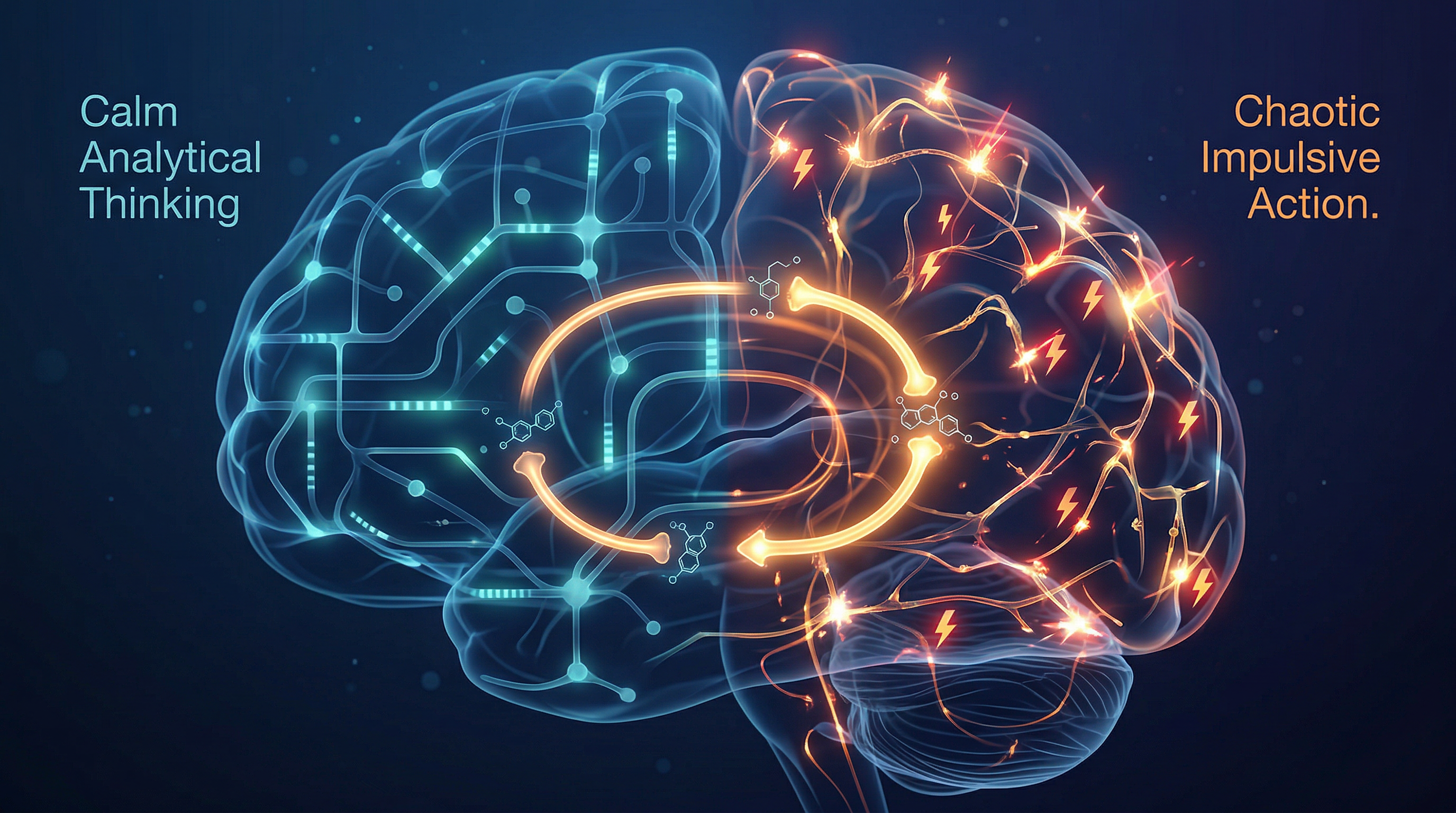
There’s a type of trader who doesn’t just want to win. They want to feel something: the tension before the entry, the relief after the exit, the tiny jolt of dopamine when the P&L flickers green. The trade is the stimulus.
In behavioral finance, this impulse has a name: sensation seeking. It’s a personality trait linked to a higher appetite for novelty, intensity, and risk. And it turns out it shows up in your brokerage history.
In a landmark paper, Mark Grinblatt and Matti Keloharju linked real stock-trading activity to a surprisingly blunt proxy for sensation seeking: speeding tickets. Investors with more speeding convictions traded more frequently and turned their portfolios over faster — and the relationship persisted even after controlling for wealth, age, and other factors. In their estimates, each additional speeding ticket was associated with roughly 10% more trades (Table II, p. 15). (Grinblatt & Keloharju, UCLA Anderson PDF)
That’s not a moral judgment. It’s a diagnosis: for some brains, inaction feels like deprivation. And in markets, deprivation creates its own kind of risk.
This article is about understanding sensation-seeking trading without shame, then building a system that protects you from it. We’ll connect personality research to modern “scroll culture,” look at what stress hormones do to your risk appetite, and finish with a practical framework — including how to use tools like a psychology-aware journal and pre-trade friction (such as Traderise) to stop overtrading before it starts.
1) What is sensation seeking (and why traders should care)?
Sensation seeking is a well-studied trait in psychology. At a high level, it describes a preference for experiences that are novel, intense, and stimulating — even when they carry risk. Some people chase stimulation through travel, extreme sports, nightlife, or fast driving. Others do it through markets.
Trading can become a stimulation engine
Trading is uniquely designed to feed sensation-seeking brains:
- Variable rewards: wins and losses arrive unpredictably.
- High feedback frequency: you can check price every second.
- Identity reinforcement: “I’m the kind of person who acts.”
- Social proof: timelines reward boldness more than consistency.
If you’re Gen Z, you’ve grown up inside a reward landscape built on infinite feeds. That matters, because your brain learns what “relief” feels like: refresh, check, tap, act.
The overtrading paradox: action feels safer than patience
Overtrading is often described as a discipline problem. But sensation-seeking trading reframes it: action is not the failure; action is the comfort behavior. In the short run, it reduces uncertainty anxiety. In the long run, it produces fees, slippage, and messy decision-making.
One reason this becomes a trap: markets offer endless opportunities to rationalize activity. You can always find a reason that sounds like analysis. The skill is learning to separate “a good trade” from “a good excuse to trade.”
2) What the research says: sensation seeking predicts more trading
Grinblatt and Keloharju’s study is one of the clearest demonstrations that psychology shows up in trading logs. They used a large Finnish dataset to connect investors’ trading activity with non-financial behavioral indicators, including speeding violations. Their results were consistent: sensation seeking predicted higher trading frequency and turnover. (Grinblatt & Keloharju, UCLA Anderson PDF)
Two implications matter for retail traders:
- Your trading style might be personality-driven. If you always feel pulled toward “one more trade,” your edge may not be the missing piece.
- More trading is not automatically more performance. The paper reports negative net performance patterns after transaction costs across groups, which aligns with the broader behavioral-finance insight that frequent trading often degrades returns. (Grinblatt & Keloharju, UCLA Anderson PDF)
Overtrading is rarely a strategy problem. It’s often a nervous-system problem: your brain is trying to regulate uncertainty by creating motion.
3) From doomscrolling to chartscrolling: the attention loop that fuels overtrading
Let’s talk about the modern environment. Trading doesn’t happen in a vacuum — it happens in the same attention economy that trained you to keep refreshing.
Doomscrolling, FOMO, and compulsive checking
Research on doomscrolling finds it’s associated with fear of missing out (FOMO) and problematic social media patterns. That’s relevant because markets provide an always-available “breaking news” stream, which makes compulsive checking feel rational. (Applied Research in Quality of Life (PMC))
In trading, doomscrolling becomes chartscrolling:
- You open your app “just to check.”
- You see a move you “missed.”
- You feel behind.
- You trade to erase the feeling.
Dopamine-scrolling and variable reinforcement
A related concept in public health writing is “dopamine-scrolling”: the habit of scrolling for novelty, driven by reward mechanisms and variable reinforcement schedules. Whether you’re scrolling TikTok or a watchlist, the underlying loop is similar: intermittent reward keeps you engaged longer than you intended. (Perspectives in Public Health (PMC))
Many traders underestimate this because they frame it as information consumption. But the emotional reality is closer to craving management. If you feel jittery when you can’t check price, that’s a signal: your attention system is over-conditioned.
Build friction where your impulse lives
If your overtrading is driven by stimulation, the fix isn’t “try harder.” It’s adding smart friction: a pre-trade checklist, cooldown timers, and a journal that forces you to name the real reason you’re clicking.
Try Traderise Free →Traderise is useful here because it makes your process visible at the moment you’re most likely to improvise.
4) Stress, cortisol, and why volatility can hijack your risk appetite
Even if you’re sensation seeking by trait, your behavior changes with physiology. Under stress, your brain reallocates resources: away from long-horizon planning and toward immediate threat management.
Researchers studying financial traders have proposed that stress hormones help explain why risk appetite collapses during volatile markets. A University of Cambridge report summarizing this line of research notes that in one field study of London traders, cortisol rose 68% over a two-week period as market volatility increased. In a lab component, 36 volunteers received hydrocortisone for eight days, raising cortisol levels comparably; chronically elevated cortisol reduced willingness to take risks, with the risk premium falling 44%. (University of Cambridge)
Why does this matter for retail traders?
- Volatility isn’t just a chart feature. It’s a body event.
- When stress rises, your “risk rules” feel different. Stops feel too tight; sitting out feels intolerable; you chase clarity through action.
This is one reason sensation-seeking trading gets worse during high-volatility news cycles: your stimulation drive collides with a stress-driven narrowing of attention.
5) How to diagnose sensation-seeking overtrading (without gaslighting yourself)
“Am I sensation seeking?” isn’t a personality quiz. It’s a pattern-recognition exercise.
Behavioral markers in your own trade log
Look for these signatures over the last 30 trades:
- Frequency drift: you trade more as the session goes on, even when setups worsen.
- Timeframe collapse: you start as a swing trader and end the day scalping.
- “Just checking” entries: you enter right after opening the app.
- Emotion-driven sizing: size correlates with boredom, not conviction.
- Revenge-adjacent behavior: you trade after frustration, but you call it “making it back.”
If you use a journal (or you should), you can quantify this. A simple metric: impulse rate = trades taken outside your plan / total trades. The goal is not zero; the goal is honesty.
Ask the uncomfortable question: what are you trading for?
Some traders are trading for profit. Others are trading for relief, identity, belonging, or stimulation. Profit is just the alibi.
This is where structured journaling helps. On Traderise, for example, you can treat “reason for trade” as a required field — not as a note you might skip. The difference between optional reflection and enforced reflection is the difference between a habit and a system.
6) The anti-overtrading playbook: replace stimulation with structure
Overtrading is a loop. So we don’t “motivate” our way out of it. We redesign the loop.
A) Add friction before the click
Sensation seeking thrives on speed. Your goal is to slow the moment of execution just enough for your prefrontal cortex to re-enter the room.
- Pre-trade checklist: 5 boxes. If any are unchecked, no trade.
- Two-minute rule: if you feel urgency, wait two minutes. If the setup is real, it’ll still be there.
- Cooldown timers: after any trade (win or loss), force a 5–10 minute lockout.
Platforms that support process constraints can be an advantage here. Using a tool like Traderise to standardize checklists and enforce journaling turns “discipline” into a default, not a mood.
B) Shrink your decision menu (less choice = less impulse)
When your brain wants stimulation, it will shop for complexity. You can block that by narrowing your menu:
- Trade only two setups for 30 days.
- Cap your watchlist at 15 names.
- Pick one timeframe as your “decision frame.”
This isn’t about being basic. It’s about lowering the surface area where impulse can attach.
C) Swap the stimulation source (so trading isn’t your only lever)
If you’re high in sensation seeking, you may need a replacement that satisfies your nervous system without touching your account.
- Micro-intensity breaks: 20 pushups, a brisk walk, cold water on wrists.
- Timed novelty: put novelty in a box (music playlist, new research topic) outside market hours.
- Skill stimulation: review 10 trades and label each “A/B/C quality.” The brain still gets activity — but it’s not financial.
7) A simple weekly system to reduce overtrading (without killing your ambition)
Here’s a practical framework I’ve seen work for young traders who don’t want to become monks — they just want to stop bleeding from impulsive trades.
Step 1: Write three non-negotiables
Examples:
- I only trade my two defined setups.
- I stop after 3 trades in a day.
- I never enter within 60 seconds of opening the app.
Step 2: Track one scorecard metric
Pick one:
- Impulse rate (outside-plan trades / total trades)
- Trades per day
- Average time between trades
Step 3: Do a 20-minute weekend review
Ask:
- When did I trade for stimulation instead of signal?
- What did I feel right before those trades?
- What friction would have prevented them?
A journal that makes this structured is helpful. If you use Traderise, treat the review as a weekly ritual: export your last week, tag impulse trades, and update your checklist rules accordingly.
Turn “discipline” into a design choice
Sensation-seeking trading doesn’t mean you’re broken. It means your system needs guardrails that match your brain. Build friction, track impulses, and make your process unavoidable.
Start Trading on Traderise →Use Traderise for structured journaling, pre-trade checklists, and cooldown rules that keep you from clicking your way into regret.
Sources and further reading
- Grinblatt, M., & Keloharju, M. (2008/2009). Sensation Seeking, Overconfidence, and Trading Activity. UCLA Anderson School of Management. (PDF)
- University of Cambridge (2014). Stress hormones in financial traders may trigger 'risk aversion' and contribute to market crises. (Article)
- Applied Research in Quality of Life (2022). Doomscrolling Scale: its Association with Personality Traits... (PMC). (Full text)
- Perspectives in Public Health (2025). Dopamine-scrolling: a modern public health challenge... (PMC). (Full text)