The Instagram Brain in Your Trading App: How Social Media Rewires Risk Perception
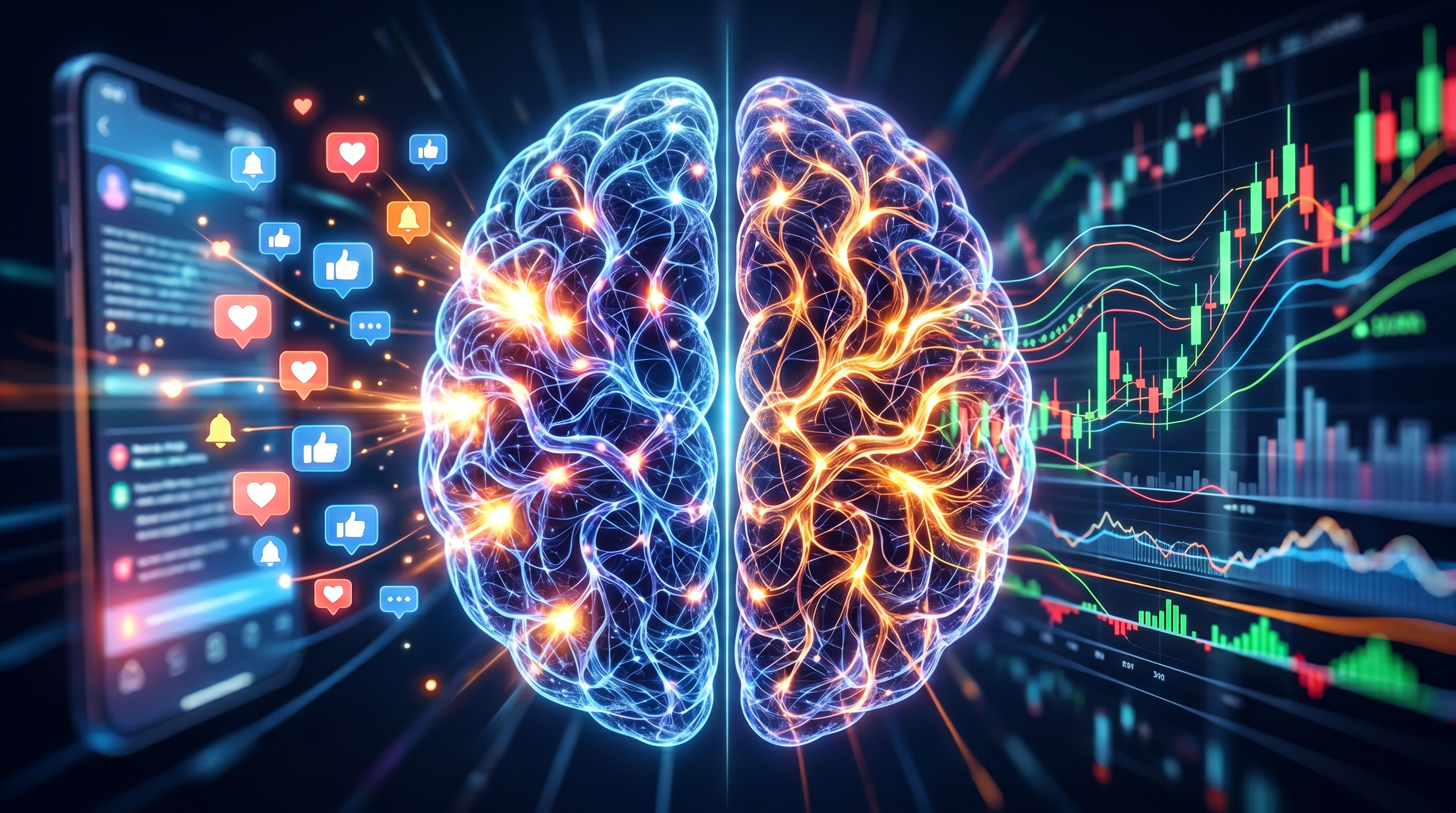
Consider two traders sitting side by side, looking at the same chart. One has been using Instagram for three hours. The other has spent that time reviewing earnings reports. Research suggests they are not making the same decision — even if they arrive at the same trade. The social media user is operating with a reward circuit that has been calibrated by thousands of micro-feedback loops: likes, shares, follower counts, the brief dopaminergic pulse of a notification. That calibration doesn't vanish when they open their brokerage app. It travels with them.
This article is not about dopamine loops in general — we've covered that elsewhere. It is specifically about the social media-to-trading pipeline: the documented neurological and behavioral changes that years of platform use produce, and how those changes manifest in five distinct trading patterns that erode performance in measurable, predictable ways. The evidence is increasingly clear, and it cuts across neuroscience, behavioral finance, and developmental psychology. Understanding it may be the most practically important thing a Gen Z trader can do.
The Nucleus Accumbens: Why Instagram and Trading Apps Speak the Same Language
The nucleus accumbens — a small cluster of neurons at the base of the forebrain — is the brain's primary reward hub. It's the structure that encodes the anticipation of reward, not just the reward itself. When something might be rewarding, the nucleus accumbens fires. When the reward arrives (or doesn't), prediction-error signals update your future behavior accordingly.
A landmark 2016 fMRI study in Psychological Science — often called the "Power of the Like" study — placed adolescents inside brain scanners and showed them Instagram-style feeds. When participants saw their own photos receiving more likes, their nucleus accumbens lit up with the same signature as it does for monetary reward and addictive substances (Sherman et al., 2016, Psychological Science). The neural response was indistinguishable from winning money.
A follow-up study in Child Development (2018) extended this to a broader age range and showed that social media use specifically recruits the nucleus accumbens and the social cognition networks in ways that become more deeply entrenched with cumulative exposure (Telzer et al., 2018, Child Development). Crucially, this recruitment was not merely correlational — increased social media engagement predicted stronger nucleus accumbens activation in response to social information over time.
What does this mean for trading? A brain that has spent years being rewarded by social validation — the like, the follower count, the share — has trained its reward circuitry to respond to social signals. When that brain opens a trading app, it doesn't leave social calibration at the door. The same nucleus accumbens that fires for a viral post fires when a trade thesis gets positive reinforcement from an online community. The same structure that habituates to rapid feedback cycles struggles with the slower, less consistent feedback of real market dynamics.
This is the core neurological claim: social media use doesn't just influence what traders think about — it influences how their reward circuitry processes all subsequent information, including financial risk.
Trading for Validation: When the Trade Is the Content
One of the most distinctive behaviors that emerges from social media-conditioned reward circuits is seeking validation for trades before — and after — executing them. This manifests in several forms.
The first is pre-trade consensus seeking: posting a chart to Discord or Twitter with "thoughts?" before entering a position. This behavior feels like due diligence — you're gathering information, stress-testing your thesis. But what's actually happening neurologically is that the trader is routing a financial decision through a social validation circuit. The question is not just "am I right?" but "do others confirm that I'm right?" — and the dopaminergic reward of social agreement can be sufficient to trigger execution even when the underlying analysis is thin.
Research on social investing platforms has documented this mechanism quantitatively. A 2025 study in PLOS One examining data from Xueqiu.com, China's leading investor social platform, found that traders who sought social confirmation were significantly more likely to exhibit the disposition effect — holding losers and selling winners — suggesting that social validation distorts the fundamental feedback loop between outcomes and future decisions (PLOS One, 2025). Related research by Heimer found that access to social trading networks nearly doubles the magnitude of the disposition effect — meaning social media does not just amplify existing biases, it recruits entirely new ones.
The second form is post-trade P&L performance. Screenshots of winning trades are now a content genre with its own aesthetic conventions — the green number, the percentage gain, the carefully cropped brokerage interface. Traderise's journaling tools show that traders who share P&L publicly have systematically different holding period behaviors than those who don't: they are more likely to close positions at psychologically meaningful numbers (round percentages, account milestones) rather than technically justified targets, because the content narrative demands a clean number.
This is not moral failing. It is the predictable output of a brain that has been trained to optimize for engagement metrics rather than expected value. The trade has become the content, and content logic is overriding financial logic.
Viral Tickers and the Herding Mechanism
The most quantitatively documented consequence of social media's role in trading is herding behavior — the tendency of retail investors to move in coordinated waves toward the same assets, driven by social signal rather than fundamental analysis.
A 2022 study in Frontiers in Physics analyzed machine-learning-processed social media sentiment alongside actual trading data and found that herding behavior among retail investors is "strongly related to the sentiment in social media at the cross-sectional level" and became substantially more pronounced after COVID-19 — the period when social media usage and retail trading participation simultaneously surged (Frontiers in Physics, 2022). The key mechanism identified was AICA (Abnormal Information Creation Activity): spikes in social media discussion around specific stocks reliably preceded coordinated retail buying.
The retail herding pattern driven by social media follows a predictable sequence. A stock gains attention — often through a combination of short squeeze potential, a compelling narrative, and early gains from initial buyers. The attention generates content. The content generates more attention, and the nucleus accumbens-calibrated brains of the content consumers register: "this is where the social reward is." They buy not because of valuation analysis but because buying is where community membership sits. The Oliver Wyman Forum's survey of 300,000 investors found that social media was the top reason 55% of Gen Z investors said they got into investing — an extraordinary number that suggests the pipeline from platform to portfolio is not incidental but structural.
The MIT IDE's 2024 analysis of retail options trading documents the downstream consequences: retail options traders systematically exhibit the disposition effect (selling winners too early, holding losers too long), with the pattern most pronounced in highly-discussed, socially visible securities (de Silva et al., MIT IDE, 2024). This is consistent with a model in which social attention — rather than analytical rigor — is driving entry decisions, leaving traders anchored to socially-constructed price reference points rather than fundamental value.
What the viral ticker phenomenon reveals is a fundamental category error that social media normalizes: treating trending as signal. In platform logic, trending content is valuable content. In market logic, trending assets are often overvalued assets. The Instagram-trained brain applies the first heuristic to the second domain — with predictable consequences.
The Survivorship Bias Content Machine and Risk Miscalibration
Of all the mechanisms through which social media distorts trading behavior, the survivorship bias problem may be the most insidious — because it operates through what is not shown.
Social media financial content is subject to extreme positive-selection pressure. A trader who turns $500 into $50,000 generates a story with viral potential. A trader who turns $50,000 into $5,000 does not. The influencer with a 10x gain will post it; the influencer with a 90% drawdown will delete their account or quietly pivot to other content. The algorithm rewards success stories because success stories generate engagement — outrage, aspiration, and comparison all drive time-on-platform.
The result is that a trader whose primary financial education has come from social media has been exposed to a radically non-representative sample of trading outcomes. Research from SAGE Journals by Sharpe and Spooner (2025) examining variable reward structures in digital media found that sporadic, unpredictable positive reinforcement — exactly what the social media success-story feed provides — produces the strongest and most persistent behavioral conditioning, with subjects dramatically underestimating base-rate failure frequencies (Sharpe & Spooner, 2025, SAGE Journals).
In concrete terms: a Gen Z trader who has absorbed three years of #RichTok, WallStreetBets highlight reels, and options-gain screenshots has calibrated their internal model of "what is a normal trading outcome" to a distribution that barely resembles reality. They have seen hundreds of 10x stories and almost no stories of ruin. When they enter the market themselves, their risk perception is calibrated to the content they've consumed — not to the actual statistical distribution of retail trading outcomes, which research consistently shows is negatively skewed for the vast majority of participants.
According to Fortune's 2026 analysis of Oliver Wyman Forum data spanning 300,000 investors, cryptocurrency makes up more than one-third of 71% of Gen Z investors' portfolios. Meanwhile, the CFA Institute found that in the US, 61% of surveyed Gen Z investors gamble online or in person — compared to 29% of non-investors. The correlation between heavy social media financial content consumption, elevated crypto allocation, and gambling behavior is not coincidental. All three share the same underlying risk-perception miscalibration produced by survivorship-bias-saturated content environments. The solution is not less engagement with markets — it is a recalibration of the feedback signal from social validation to process quality.
This risk miscalibration has a specific structural consequence: it compresses perceived downside. When your mental model of trading outcomes is built from a highlight reel, a 50% drawdown doesn't feel like a statistically predictable event — it feels like an aberration, a mistake, something that happened to you specifically because you did something wrong. This makes appropriate loss tolerance harder to maintain and revenge-oriented, recovery-seeking behavior more likely after losses.
Recalibrate Your Risk Perception
Traderise's journaling tools track your actual trade distribution over time — not the highlight reel. Build an honest baseline of your real outcomes, not the ones worth posting about.
Start Journaling on Traderise →Confusing Engagement With Due Diligence
Social media platforms have optimized for engagement — time spent, reactions, shares. But engagement is not a proxy for accuracy, quality, or financial soundness. This distinction is obvious when stated directly. It is far less obvious when a trader is scrolling at 11pm, watching a confident influencer explain a "breakout setup" to 400,000 followers while comments flood with "🚀" and "already in."
The engagement signals — likes, follower count, comment volume, view count — have been trained by social media to feel like credibility signals. This is not an accident. Platform algorithms amplify high-engagement content, which means the loudest, most emotionally compelling voices reach the most people — regardless of track record. A 2023 paper examining social media-induced trading found that a significant 67% of retail traders surveyed had bought or sold stocks based on social media discussions, while 65% rated online investment communities as "at least impartial or really reliable" sources of information — despite the evident conflict between those beliefs and rational evaluation of content quality (IJRPR Herding Behavior study, 2023).
The practical consequence is that social media-habituated traders systematically mistake popularity for validity. A ticker that is trending is not necessarily one with strong fundamentals or favorable technicals. An influencer with 500,000 followers is not necessarily more accurate than one with 5,000. But the nucleus accumbens-calibrated brain registers the social signal and assigns it informational weight — a category error that scales directly with the number of hours spent on platforms where engagement and quality are genuinely correlated.
Traderise's pre-trade checklist is specifically designed to interrupt this pattern: by requiring traders to document their analysis before execution — thesis, technicals, risk parameters — it creates a friction point between the social stimulus and the financial action. The question "what is my independent basis for this trade?" is harder to skip when it's embedded in the execution workflow.
P&L as Content: The Performance of Trading
The most novel and underexamined consequence of social media's influence on trading is the emergence of what might be called the performative trade: a position taken partly or primarily because of its content value, rather than its financial merits.
The performative trade has several recognizable forms. There's the narrative trade: entering a position because the story around it is compelling and shareable, even when the technical setup is marginal. There's the community trade: buying a stock because your Discord group is, creating social cohesion through shared financial exposure. And there's the screenshot trade: sizing a position specifically to produce a round-number P&L screenshot — not because round numbers are financially significant, but because they're better content.
Research on attention-induced trading supports the existence and financial costs of this phenomenon. A 2020 study on Robinhood users found that "large increases in Robinhood users are often accompanied by large price spikes and are followed by reliably negative returns" — consistent with a model in which attention and community membership, not valuation, drive entry (Alpha Architect, 2024, citing Barber et al.). The traders buying for social reasons are, on average, buying late and selling at losses.
The deeper problem is that performative trading generates its own reinforcement structure. A well-timed trade that produces a shareable screenshot rewards both the financial outcome and the social outcome. The brain cannot easily distinguish between "this worked because my analysis was correct" and "this worked and I got 200 likes." Over time, the social reinforcement can become the primary signal — a process that makes subsequent analysis-driven trading feel less rewarding by comparison, even when it produces better risk-adjusted returns.
Evidence-Based Interventions: Breaking the Social Media-Trading Pipeline
The neurological and behavioral effects documented above are real and measurable. But they are also addressable — not through willpower and self-monitoring alone, but through structural interventions that change the conditions under which trading decisions are made.
Implementation Intentions: If-Then Plans That Pre-empt Social Impulse
Implementation intentions — the "if-then" planning structure rigorously studied by Peter Gollwitzer and colleagues — are among the most effective behavioral interventions for interrupting stimulus-response chains. The structure is simple: "If I see a stock trending on social media, then I will not act until I complete my pre-trade checklist." The power of the if-then format is that it pre-loads the response at a time when the brain is not under social stimulus pressure — so when the stimulus arrives, the planned response deploys automatically rather than competing with the emotional pull of social signal.
Applied to the social media-trading pipeline, implementation intentions can be structured around specific triggers: "If I see a ticker mentioned more than three times in my feed today, then I will note it and evaluate it at my scheduled analysis window — not immediately." This single rule converts a reactive, nucleus-accumbens-driven impulse into a deliberate, prefrontal-cortex-managed process.
Friction and Delayed Execution
Behavioral economics research consistently shows that adding friction to impulsive behaviors reduces their frequency, even when the friction is minimal. In trading, friction can take the form of a mandatory waiting period between identifying a socially-sourced trade idea and executing it — 24 hours is a research-backed duration that allows the social stimulus to decay while preserving genuine conviction. Traderise's risk management tools can enforce these waiting periods structurally, making the delay a system constraint rather than a willpower test.
The waiting period also serves a second function: it creates a natural experiment. A trade idea that still seems compelling 24 hours after the social media stimulus has faded is a meaningfully better trade than one that felt urgent in the moment. The urgency was the platform engineering, not the opportunity.
Pre-Commitment to Independent Analysis
The most powerful structural defense against social media's influence on trading decisions is the pre-commitment to independent analysis: establishing, before any trade, a documented basis that does not depend on social signal. This means writing down your thesis — what is the setup, what is the catalyst, what is the entry criteria, what is the stop — before consulting social media for confirmation.
This sequence reversal is critical. When analysis precedes social media consultation, the social signal is evaluated against an existing framework. When social media precedes analysis, the social signal becomes the framework, and subsequent analysis becomes rationalization. The brain's confirmation bias will reliably find support for whatever the social environment has primed it to believe.
Traderise's journaling and pre-trade workflow is built around this principle: thesis documentation is a required step before execution, creating a paper trail of independent reasoning that can be reviewed against outcomes to build genuine analytical skill over time.
Calibrating to Real Outcome Data
Because survivorship bias is a content-environment problem, the corrective is a data environment problem. Traders who track their own outcomes rigorously — win rate, average win, average loss, maximum drawdown, Sharpe ratio — have access to a sample of trading reality that social media cannot distort. Over time, a personal trading journal becomes more informative than any feed, because it contains the full distribution of outcomes rather than the curated highlight reel.
This recalibration is not instantaneous. Years of social media exposure have shaped baseline risk expectations, and those expectations don't reset from a single month of journaling. But the cumulative effect of tracking real outcomes against actual probabilities gradually corrects the distorted distribution that the content environment has installed. The social media brain can be retrained — not by avoiding all external information, but by weighting first-person outcome data more heavily than second-hand success narratives.
Build a Trading Process That Runs on Evidence, Not Engagement
Traderise gives you structured journaling, pre-trade checklists, and risk management tools designed specifically to interrupt social media's influence on your decision-making. Trade from your analysis, not your feed.
Try Traderise Free →