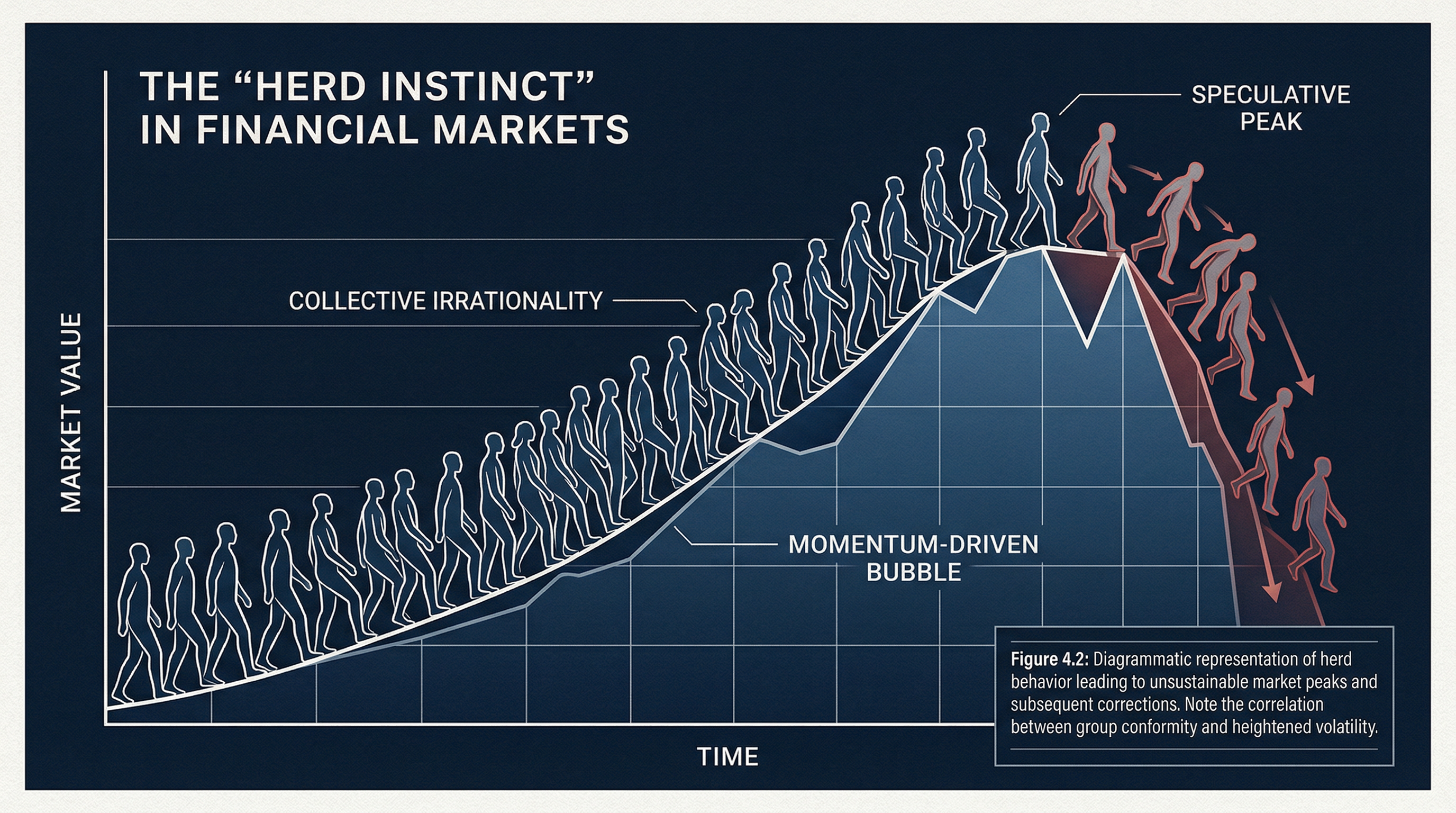
January 2021. A video game retailer with declining revenues and shuttered mall stores was trading at $483. Not because fundamentals justified it. Not because institutions had discovered hidden value. But because millions of individual traders, watching each other act, decided that the crowd must know something. The GameStop squeeze was many things — a rebellion, a cultural moment, a hedge fund stress test. But above all, it was the purest real-time demonstration of herding behavior ever captured in market data. And the people who bought at $400+ didn't do so despite being smart. They did it because of a cognitive process so deeply wired into human neurology that it helped our species survive for 200,000 years. Today, it's eating your trading account.
The Neuroscience of Herding: Your Brain Is Designed to Follow the Crowd
Herding behavior in finance refers to the tendency of investors to mimic the actions of a larger group, abandoning their own independent analysis in favor of following the crowd. In evolutionary biology, this behavior is highly adaptive: when one member of the group runs from a predator, it's rational for others to follow without waiting to personally verify the threat. The cost of being wrong when you don't follow (being eaten) vastly outweighs the cost of being wrong when you do (unnecessary running).
A 2024 study at Harvard's Decision Science Lab used fMRI imaging to monitor brain activity during simulated group investment decisions. When subjects saw their peers making a particular investment choice, the brain's ventromedial prefrontal cortex — associated with social conformity and group harmony — actively suppressed activity in the dorsolateral prefrontal cortex — responsible for independent analytical reasoning. Literally: the social pressure of the crowd shut down your analytical brain.
4 Types of Herding That Drive Market Irrationality
- Informational cascades: Following others because you assume they have information you don't
- Reputational herding: Institutional managers buying what peers buy to avoid looking foolish if they miss a rally
- Sentiment contagion: Catching the emotional energy of crowd euphoria or panic
- Algorithmic amplification: Social media algorithms that accelerate trending narratives, creating feedback loops
The crowd is right most of the time in established trends — and catastrophically wrong at inflection points. The skill is distinguishing between trend participation and bubble participation. Traderise's risk controls include maximum exposure limits that prevent any single herd-driven trade from becoming an account-defining event.
The Research: How Herding Destroys Value at Scale
A comprehensive 2025 study in the Journal of Finance analyzed 15 years of retail trading data and found that herding behavior — measured by the correlation of retail buy orders in the same stocks — increased by 340% during high-volatility periods compared to calm markets. More tellingly, the average herding-driven buy occurred 23 trading days after the initial move, meaning most herd participants were buying after institutional money had already established its position and was preparing to distribute.
The study's most sobering finding: the 10% of trades most attributable to herding behavior — buying into the most popular stocks during the peak of social media momentum — generated negative average returns of -18.4% over the subsequent 90 days. The crowd wasn't right. The crowd was the exit liquidity for smarter money.
2025's Greatest Herding Events — Decoded
The AI options frenzy of Q2 2025 provides a textbook herding case study. After Nvidia's exceptional earnings in May 2025, retail options buying in AI-adjacent stocks surged 420% in the following two weeks. Trading community discussion threads on Reddit's WallStreetBets hit all-time engagement records. The sentiment was overwhelming: "This is only the beginning." Within six weeks, the AI stock basket had given back 31% from its peak. The herd had bought the blow-off top. Social media had amplified the narrative beyond what fundamentals could support, and the participants who bought based on crowd conviction experienced the full unwind.
Trade With Your Brain, Not Against It
Traderise includes built-in trading journals, risk controls, and psychology-aware features designed to help you make better decisions.
Try Traderise Free5 Ways to Trade Against the Herd Without Being Contrarian for Its Own Sake
1. Measure, Don't Feel, Sentiment
Sentiment should be quantified, not experienced. Use Fear & Greed indices, put/call ratios, AAII sentiment surveys, and short interest data to measure crowd positioning mathematically. When multiple sentiment indicators simultaneously reach extreme readings, treat it as a risk flag — not a trading signal by itself, but a warning to reduce exposure and tighten risk parameters. Log your sentiment readings in Traderise's pre-trade journal before every significant trade.
2. Check Volume and Price Action Context
Herding moves typically feature exponentially increasing volume, accelerating price action, and declining analytical discussion quality in trading communities — more "to the moon" language, fewer fundamental discussions. These are structural signals that you may be late to a crowded trade.
3. Apply the "Late Bus" Test
If you first heard about this trade from a non-financial friend, a social media viral post, or a mainstream news headline, you are late to the bus. The herd has already boarded. At this stage, you are not getting a position — you are becoming the exit liquidity. Reduce size or pass entirely.
4. Pre-Commit to Position Limits on High-Sentiment Trades
For any trade in a stock or asset with extremely elevated social media sentiment, pre-commit to a maximum position size of 50% of your normal size. The discipline of reduced size keeps herding opportunities from becoming account-risk events. Traderise's position sizing tools let you automate these category-specific sizing rules.
5. Wait for the Second Setup
The most reliable way to benefit from herding without being the victim of it: wait for the herd-driven move to exhaust and for a secondary entry point to develop at a structurally superior level. The herd creates the move. Patient, process-driven traders profit from the mean reversion or the re-accumulation that follows.
When the Herd Is Right: Trend Participation vs. Bubble Participation
Not all herding is irrational. Momentum in markets is real, and it's often rational to be long what is going up and short what is going down. The key distinction is between trend participation — buying into a well-established, fundamentally supported move early enough that you have positive risk/reward — and bubble participation — joining a crowd-driven mania after the risk/reward has already become unfavorable. Research by AQR Capital Management shows that systematic trend-following strategies — which essentially follow market "herds" but with disciplined entry and exit rules — have produced positive risk-adjusted returns over 100+ years of data. The herd can be right for a long time. It's the timing that matters.
Building Your Herd-Immune Portfolio Process
The antidote to herding isn't isolationism. You don't need to ignore market trends or social sentiment. What you need is a process that uses that information as one data point among many — not as a primary driver of conviction. Research your trades independently before consulting social media. Form a view, then check how it compares to consensus. If you agree with the crowd, scrutinize your thesis more rigorously. Use Traderise's structured journal to log your independent analysis before looking at what others are saying — creating a paper trail of thinking that's yours rather than the crowd's.
Think Independently — Trade With Structure
Traderise's risk controls and pre-trade tools help you separate independent analysis from crowd contagion — so you participate in trends without becoming exit liquidity.
Try Traderise Free