Implementation Intentions: How If-Then Plans Build Unbreakable Trading Discipline
You have a trading plan. You've written it down. You know you should cut losses at 1.5%. You know you should wait for confirmation before entering. You know you should stop trading after three consecutive losers. And yet, when you're sitting in front of a live chart with real money on the line, your plan evaporates. The market is moving. Your emotions are louder than your rules. You break the plan — again.
This is not a failure of intelligence, knowledge, or willpower. It is a failure of implementation. And it is one of the most reliably documented patterns in behavioral science. The gap between knowing what to do and actually doing it under stress is not a character flaw — it is a structural property of how the human brain operates when arousal is high.
The good news is that this gap has a solution, and it has been tested in hundreds of controlled studies across domains ranging from exercise compliance to addiction recovery to academic performance. It is called implementation intentions — a specific form of if-then planning that has been shown, consistently and robustly, to dramatically increase the probability that people follow through on their intentions when it counts. Applied to trading discipline, implementation intentions may be the most evidence-based behavioral tool available to retail traders.
What Implementation Intentions Are — and Why They Work
The concept of implementation intentions was introduced by psychologist Peter Gollwitzer in the 1990s and has since become one of the most replicated findings in social psychology. A 2006 meta-analysis by Gollwitzer and Sheeran, reviewing 94 independent studies with a combined sample of over 8,000 participants, found a medium-to-large effect size (d = 0.65) for implementation intentions on goal achievement — making it one of the highest-performing simple behavioral interventions in the literature (Advances in Experimental Social Psychology, 2006).
The key distinction is between two types of intentions:
- Goal intentions: "I intend to follow my trading plan." These are statements of aspiration. They specify what you want to achieve but not when, where, or how you will act.
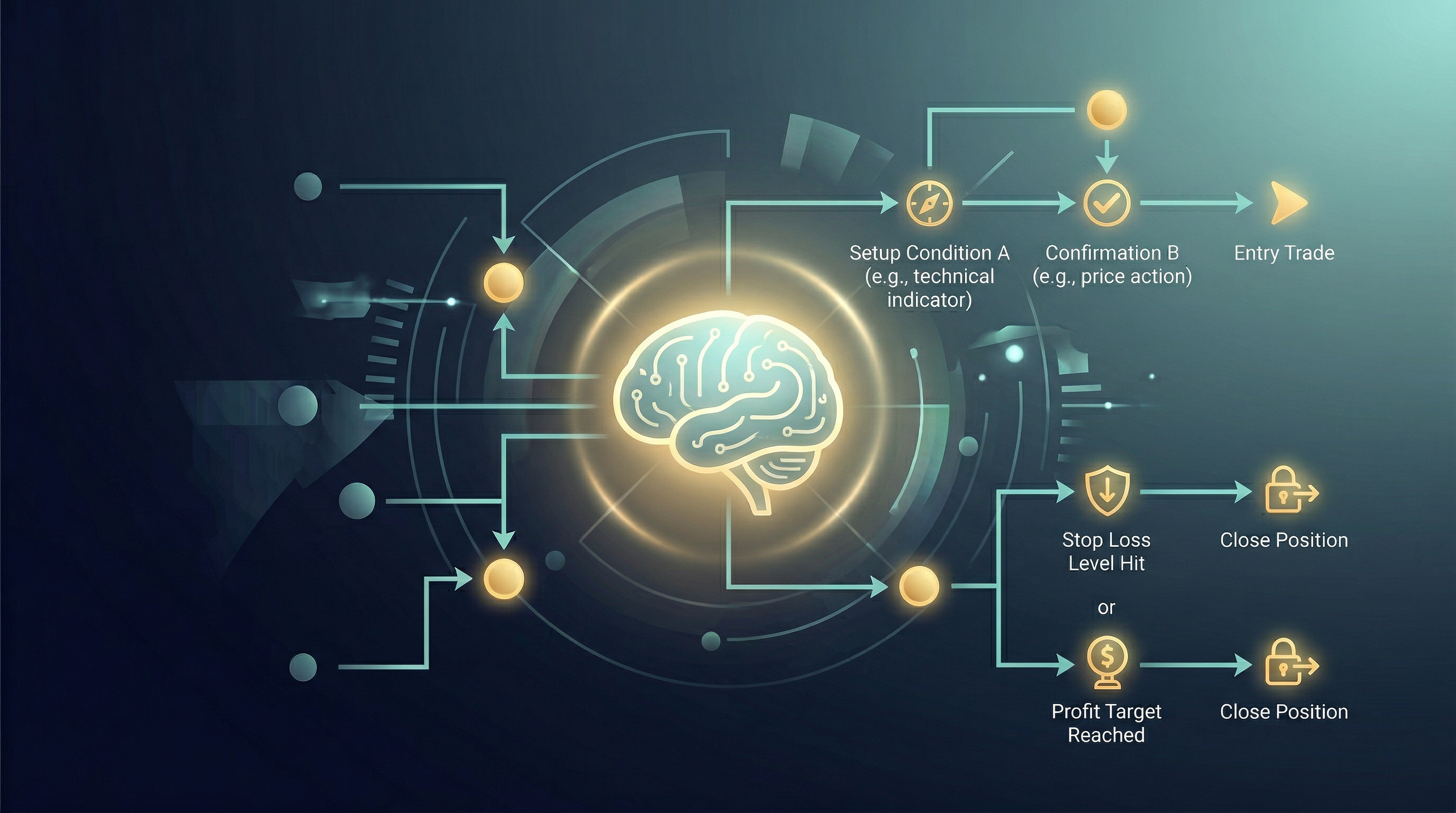
- Implementation intentions: "If situation X arises, then I will perform response Y." These are specific behavioral commitments that link a trigger condition to a pre-planned response.
The format is always the same: If [situation], then [behavior]. For example: "If my position drops 1.5% from entry, then I will close the trade immediately, without hesitation." Or: "If I have taken three consecutive losses today, then I will stop trading and close my platform for the rest of the session."
The Cognitive Mechanism: Mental Simulation and Automatic Activation
Why does this simple linguistic structure produce such large behavioral effects? The mechanism, according to Gollwitzer's research, operates on two levels. First, formulating an implementation intention creates a mental simulation of the future scenario — the "if" part. This pre-activation of the situation in memory makes the cue more cognitively accessible. The brain, in a sense, begins watching for it.
Second — and this is the critical insight for traders — when the trigger situation is eventually encountered in real life, the behavioral response fires automatically, without requiring deliberate, effortful decision-making. Gollwitzer describes this as "outsourcing control to the environment." The behavior becomes, in his terminology, "strategic automaticity": planned in advance but executed without conscious deliberation.
For traders, this is transformative. The problem with emotional trading is not that traders don't know their rules — it's that they encounter trigger situations (a rapidly moving price, a sudden loss, a FOMO-inducing breakout) in a state of heightened arousal where the deliberate, rule-following parts of their brain are partially offline. Implementation intentions bypass the need for deliberation entirely. The plan is already made. The trigger fires, the response activates. No willpower required in the moment.
The Emotional Trading Problem: Why Feelings Override Logic
To appreciate why implementation intentions are particularly suited to trading, it helps to understand the precise mechanism by which emotion disrupts rational decision-making in financial contexts.
George Loewenstein and colleagues, in their influential 2001 paper "Risk as Feelings" published in Psychological Bulletin, identified a systematic divergence between risk as it is cognitively assessed and risk as it is felt in the moment (Loewenstein, Weber, Hsee, & Welch, 2001). Their core argument: when people face risky decisions, their behavioral responses are often driven by immediate emotional reactions — fear, excitement, anxiety, regret — rather than by their calculated, deliberate evaluations of the situation. Crucially, emotional reactions and cognitive evaluations can diverge significantly, and when they do, emotions tend to win.
This divergence is particularly pronounced in volatile financial markets. Research on market exposure and anxiety, including work by Qin, Liao, Zheng, and Liu (2019) published in Frontiers in Psychology, demonstrated that even moderate portfolio losses activate anxiety responses that measurably impair subsequent decision-making quality. The anxiety is not simply an unpleasant feeling — it actively degrades the cognitive resources needed to execute a disciplined plan.
Kahneman's Dual-Process Framework
Daniel Kahneman's work on decision-making under uncertainty — culminating in the Nobel Prize-winning prospect theory framework he developed with Amos Tversky — provides an essential theoretical backdrop. Kahneman's "Thinking, Fast and Slow" framework distinguishes between System 1 (fast, automatic, emotional) and System 2 (slow, deliberate, rational) cognitive processes. Under normal, low-stress conditions, traders can engage System 2: they read their plan, consider their rules, and make measured decisions.
But financial losses, as Kahneman and Tversky's 1979 prospect theory research demonstrated, are not experienced linearly. Losses are felt approximately 2 to 2.5 times more intensely than equivalent gains — a phenomenon called loss aversion. When a trade moves against a position, this asymmetric pain response triggers a System 1 override: the fast, emotional brain takes precedence, and carefully constructed rules are suddenly very hard to follow.
Implementation intentions work precisely at this System 1 / System 2 interface. By converting deliberate rules into automatic response patterns — "if X then Y" — they effectively encode System 2 logic into a System 1-compatible format. The if-then plan becomes its own fast, automatic response that can compete with, and often override, the emotional impulse.
Implementation intentions don't require more willpower — they replace the need for willpower. The research consistently shows that people who form specific if-then plans outperform those who simply "try harder" to follow their intentions, even when effort levels are equal. For traders, this means your job is not to be stronger in the moment — it's to write better plans before the moment arrives.
Implementation Intentions Applied to Trading: A Practical Framework
The power of implementation intentions comes from their specificity. Vague rules ("I'll manage my risk better") produce weak behavioral anchors. Precise if-then formulations create strong ones. The following framework outlines how to apply this research directly to common trading discipline challenges.
1. Stop-Loss Execution
Perhaps the most universal failure in retail trading is the inability to take a stop-loss when it is hit. Traders watch the price touch their stop level, and instead of closing the trade, they widen the stop, remove it entirely, or simply hold and hope. Psychologically, this is prospect theory's "risk-seeking in the domain of losses" in action — when sitting at a loss, the brain prefers the gamble of holding over the certainty of taking the loss.
Goal intention (weak): "I will always honor my stop-losses."
Implementation intention (strong): "If the price touches my stop level, then I will close the trade immediately at market, before I look at the chart again."
The specificity matters. "Before I look at the chart again" removes the opportunity for the emotional brain to generate a counter-narrative ("it's just a wick, it'll recover"). The response is executed before deliberation can occur.
2. Daily Loss Limit Adherence
Most trading plans include a daily maximum loss, and most traders breach it regularly. The emotional context of being "down on the day" creates exactly the risk-seeking, breakeven-seeking state described in Kahneman and Tversky's prospect theory framework — the mental urgency to close a negative "mental account."
Goal intention (weak): "I won't exceed my 2% daily loss limit."
Implementation intention (strong): "If my account is down 2% from today's opening balance at any point during the session, then I will close all positions, shut the trading platform, and not reopen it until tomorrow's pre-market."
The behavioral response here includes physical actions (closing the platform), not just mental commitments. Gollwitzer's research shows that linking implementation intentions to specific actions — especially those that change the physical environment — increases effect sizes substantially.
3. Entry Discipline and FOMO
Fear of missing out is one of the dominant drivers of impulsive entries. A trader sees a setup moving rapidly in their anticipated direction without them, feels the acute discomfort of watching a "missed" trade, and enters impulsively at a poor price with no defined stop.
Goal intention (weak): "I will only enter trades that meet my setup criteria."
Implementation intention (strong): "If I feel the urge to enter a trade that has already moved past my entry zone, then I will open my trading journal, write down what I'm feeling and why, and wait five minutes before making any decision."
The five-minute wait is not arbitrary — it is calibrated to the typical duration of an acute emotional impulse. Research on affective forecasting suggests that most emotional urgency peaks and begins to subside within 3-7 minutes when no action is taken. The journaling step serves a secondary purpose: externalizing the emotional state (naming it, writing it) reduces its intensity through what psychologists call "affect labeling."
4. Revenge Trading Prevention
After a loss, the brain enters what prospect theory researchers describe as the "loss domain" — a state of heightened risk-seeking in which impulsive, oversized re-entries become dramatically more likely. Pre-committing to a behavioral response to this specific emotional state is one of the highest-leverage applications of implementation intentions in trading.
Implementation intention: "If I close a losing trade and feel the urge to immediately re-enter the market, then I will leave my trading desk, walk for ten minutes, and only return when I can articulate a trade thesis based solely on current market conditions — with no reference to my previous loss."
The final clause — "with no reference to my previous loss" — is a key diagnostic. If the trader cannot construct a trade thesis without mentioning their loss, the impulse is emotional, not analytical. This self-check is borrowed from CBT-informed behavioral protocols and has been adapted here as an implementation intention trigger.
Turn Your Rules Into Automatic Behavior
Traderise helps you build structured trading habits with built-in guardrails, journaling tools, and risk management features designed around behavioral science.
Try Traderise Free →Why Goal Intentions Fail Under Pressure
It is worth examining more carefully why goal intentions — the kind most traders write in their trading plans — fail so reliably under pressure. Three mechanisms are particularly relevant.
Attentional Demand Under Arousal
Goal intentions require active, working-memory-intensive processing. When you are in a trade that is moving rapidly, your attentional resources are almost entirely captured by the price action. There is little cognitive bandwidth left to retrieve a written rule, evaluate whether the current situation meets its conditions, overcome emotional resistance, and execute the planned behavior. The rule is simply not competitive with the immediate sensory reality of the market.
Implementation intentions reduce this attentional demand to near zero by pre-forming the situation-response link. The recognition of the trigger is automatic; the response to the trigger is automatic. No working memory bandwidth is required in the moment.
Ego Depletion and Decision Fatigue
Trading sessions are cognitively taxing. By the afternoon of a volatile session, a trader's capacity for self-regulation has been substantially depleted — a phenomenon studied extensively under the label of "ego depletion" and more recently framed as "decision fatigue." Research consistently shows that self-control failures increase as cognitive resources are exhausted.
Goal intentions rely on self-control. Implementation intentions do not — they convert behavior into habit-like automaticity, which requires minimal deliberate control. This makes if-then plans especially valuable later in the trading day, precisely when willpower-based approaches are least reliable.
Optimism Bias and the Planning Fallacy
When traders write goal intentions ("I will cut losses quickly"), they typically do so in a calm, reflective state. In this state, they systematically underestimate how compelling it will feel to break the rule when market conditions conspire against them. This is the planning fallacy in action — the tendency to assess plans based on best-case scenarios rather than realistic distributions of future emotional states.
Implementation intentions partially counteract the planning fallacy by forcing traders to mentally simulate the challenging trigger condition explicitly: "When the price hits my stop and I feel the urge not to take the loss, here is exactly what I will do." This mental simulation creates more accurate forecasts of the behavioral challenge and, crucially, pre-loads the response.
Designing High-Quality If-Then Plans for Trading
Not all implementation intentions are equally effective. Research has identified several features that distinguish high-quality from low-quality if-then plans.
Specificity of the Situational Cue
The "if" component must be concrete and observable, not psychological. "If I feel anxious" is a poor cue because emotional states are ambiguous and internally monitored. "If my P&L crosses -$500 for the day" or "If I have taken three consecutive losing trades" are better cues because they are external, measurable, and unambiguous. There is no gray area about whether the trigger has fired.
Behavioral Response Completeness
The "then" component should be a complete behavioral sequence, not a vague intention. "Then I will be more careful" is incomplete. "Then I will: (1) close all open positions at market, (2) screenshot the current chart with a brief annotation, (3) step away from the trading desk for 20 minutes, and (4) only return after writing one sentence about why my plan was or was not executed correctly" is complete. The more detailed the response, the less cognitive work is required in the high-arousal moment.
Anticipating Interference
Gollwitzer and colleagues have extended the implementation intentions framework with what they call "mental contrasting" — the practice of explicitly imagining the obstacles that will arise when you try to execute your if-then plan. For traders, this means asking: "What will my emotional brain tell me when this trigger fires? What rationalizations will I generate?" Having pre-answered these objections in writing significantly reduces their power in the moment.
A complete trading implementation intention might therefore look like: "If I have taken three losses today reaching my 2% daily limit, then I will shut the platform and stop trading. I know I will feel the urge to tell myself 'this next setup is different' or 'I can make it back.' I am pre-deciding that those thoughts are not valid signals — they are predictable emotional responses. My decision has already been made."
Implementation Intentions in Risk Management: The Bigger Picture
Beyond individual trade decisions, implementation intentions can be applied systematically to the entire risk management architecture of a trading practice. This broader application represents a shift from using if-then plans as individual behavioral patches to using them as the foundational structure of a complete trading system.
Position Sizing Rules
Position sizing decisions are among the most emotionally vulnerable in trading. After a winning streak, traders tend to increase size beyond their system's parameters — the well-documented overconfidence effect. After a losing streak, some traders reduce to paralysis, missing high-probability setups. Others go the opposite direction, increasing size in an attempt to recover losses quickly.
Implementation intention: "If I am about to enter a trade, then I will calculate position size using my standard formula [1% risk of account equity, divided by (entry - stop) in price terms] before I look at the current price action. Size is always determined by the formula, never by feel."
Implementation intention: "If I have had three consecutive winning trades, then I will check my last five position sizes to ensure I have not been gradually increasing beyond my parameters before placing the next trade."
Pre-Market Preparation as an If-Then Structure
A pre-market routine is already a behavioral system — but it becomes significantly more durable when framed as implementation intentions rather than aspirational checklist items. "I will do my pre-market analysis" is a goal intention. "If it is 8:00 AM and I am sitting at my trading desk, then I will open my watchlist, mark the key levels on my top three setups, write my thesis for each in two sentences, and set price alerts before touching any trade entry" is an implementation intention.
This specificity is not pedantic — it is exactly the level of detail that transforms a routine from something you aspire to do into something that fires automatically in response to environmental cues. Traders who use platforms like Traderise can build pre-trade checklists directly into their workflow, converting aspirational routines into structured, prompted behaviors that approximate the automaticity of implementation intentions.
Post-Trade Review Protocol
The behavioral science literature on habit formation consistently identifies feedback loops as critical for consolidating behavior change. Implementation intentions work best when paired with regular review — not of outcomes (whether the trade made money) but of process (whether the if-then plan was executed correctly).
Implementation intention: "If I have completed my trading session for the day, then I will spend 10 minutes reviewing each trade: did I execute my entry, stop, and sizing rules correctly? For any rule I broke, I will write one sentence explaining which implementation intention I need to strengthen or revise."
This review protocol turns the trading journal from a performance log into a behavioral calibration tool — exactly the function it should serve from a psychological standpoint.
The Neuroscience of Habit Formation and Why Pre-Commitment Works
The effectiveness of implementation intentions has neurological underpinnings that connect to the broader science of habit formation. Habits are encoded in the basal ganglia — a set of brain structures that specialize in chunking sequences of behavior into automatic routines triggered by environmental cues. Implementation intentions effectively bootstrap this process by deliberately creating the cue-response associations that normally require hundreds of repetitions to develop.
When you formulate an if-then plan with genuine commitment and mental simulation, you are essentially telling the basal ganglia: "Treat this cue-response pair as a chunk." Repeated exposure to the actual trigger in live trading then reinforces this encoding rapidly. Traders often report that after even a few successful executions of an implementation intention, the response begins to feel automatic — not forced.
This is the deeper promise of implementation intentions for traders. Discipline is not a character trait you either have or lack. It is a behavioral architecture you construct, neuroscience-based tools included. The if-then plan is the blueprint; repeated correct execution is the construction. Over time, what required explicit attention and effort becomes background processing. The discipline becomes, in the most literal neurological sense, automatic.
Trading platforms that incorporate structured journaling and rule-tracking — like Traderise, which allows traders to log rule adherence alongside P&L — create the feedback infrastructure that accelerates this encoding process. When you can see, over a series of 30 or 50 trades, exactly which if-then plans you executed and which you violated, the patterns become visible, and the motivation to consolidate correct behavior strengthens.
Building Your Implementation Intentions System: A Starting Template
The following template is designed as a starting point. Effective implementation intentions must be personalized — they work because they are specific to your trigger situations and your behavioral responses. But this structure provides the scaffolding.
Tier 1: Entry Discipline
- "If I am about to enter a trade, then I will verify it meets all three of my setup criteria before touching the order ticket."
- "If a trade I missed is already moving in my anticipated direction, then I will mark it in my journal as 'missed' and wait for the next valid setup."
- "If I feel strong urgency to enter without a clear setup, then I will name the emotion in my journal before doing anything else."
Tier 2: Trade Management
- "If my position hits my predefined stop level, then I will close it at market immediately, without adjusting the stop first."
- "If my position reaches my first target, then I will take partial profits according to my plan — 50% off — before I reassess."
- "If I am holding a position and I feel anxious, then I will check whether it is at or past my plan's maximum adverse excursion — if yes, I exit; if no, I step away from the screen for five minutes."
Tier 3: Session-Level Risk
- "If my account equity drops 2% from today's opening balance, then I will close all positions and stop trading for the day."
- "If I have had three consecutive losing trades, then I will take a 30-minute break before any further trades."
- "If it is after [time limit], then I will not enter any new positions regardless of how compelling the setup appears."
These are not aspirations — they are pre-decisions. The behavioral research is clear: the more you specify the "if" in advance and mentally simulate it, the more automatic and reliable the "then" becomes when the actual situation arises.
From Rules to Reflexes: The Long Game
The promise of implementation intentions for trading is not just better discipline tomorrow. It is, over time, the transformation of what requires effortful self-regulation into what becomes second nature. The stop-loss that once required tremendous emotional resistance to take becomes, after sufficient practice guided by if-then planning, a reflex. The daily loss limit that once felt like an arbitrary cage becomes a protective structure you are grateful for.
This is not idealism — it is the logical endpoint of what the behavioral science shows. Pre-committing to specific behavioral responses to specific trigger situations creates mental representations that grow more robust with each successful execution. The more often the plan fires correctly, the stronger the neural encoding. The more specific and vivid the original if-then formulation, the faster this consolidation occurs.
For traders serious about building a sustainable practice — one that can generate consistent results over months and years rather than spectacular wins followed by catastrophic blowups — implementation intentions represent one of the most evidence-based, practically applicable tools in behavioral finance. They do not require expensive software, a trading coach, or a complete overhaul of your strategy. They require careful thinking, honest self-assessment of your behavioral vulnerabilities, and the discipline to write your plan before the emotional moment arrives.
The if-then plan you write tonight, when the market is closed and your mind is calm, is the version of you that should be trading tomorrow. Implementation intentions are how you ensure that version shows up.
Ready to Build Better Trading Habits?
Join thousands of traders using Traderise — the platform built for disciplined, evidence-based trading. Track your rule adherence, journal your trades, and build the habits that last.
Start Trading on Traderise →