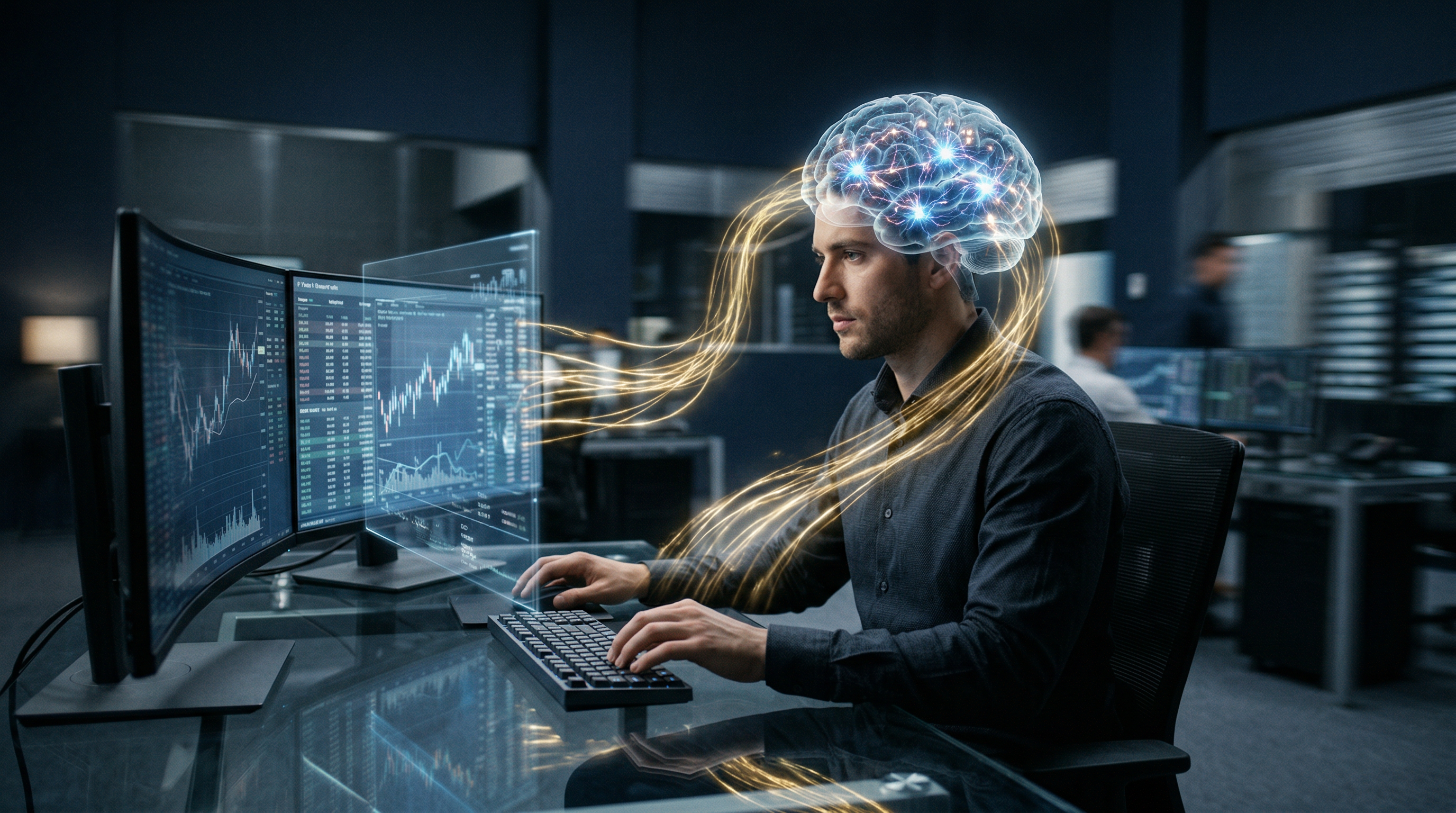
Traders describe it as "being in the zone." The market seems to slow down. Decisions come effortlessly. You're not thinking — you're responding, and your responses are precise. Counterintuitively, it feels like the easiest trading you've ever done. Psychologist Mihaly Csikszentmihalyi called this state "flow" — and his 30 years of research suggest it's not a random occurrence or a gift reserved for naturals. It's a neurological state that can be understood, cultivated, and systematically accessed. A 2025 study of professional traders found that those who experienced flow states most frequently also had the highest Sharpe ratios and the best emotional regulation during volatile sessions. Here's the science of how to get there.
What Flow Actually Is — The Neuroscience Explained
Csikszentmihalyi defined flow as a state of complete absorption in a challenging activity, characterized by effortless concentration, loss of self-consciousness, distortion of time perception, and intrinsic reward. Neuroimaging research has since identified its neural signature: flow involves a paradoxical combination of high prefrontal engagement (analytical processing) and reduced self-referential processing in the default mode network (the "self-consciousness" network). You're thinking maximally while worrying about yourself minimally.
A 2024 study published in NeuroImage found that experienced traders in self-reported flow states showed measurably superior pattern recognition accuracy, faster decision latency, and lower emotional reactivity to adverse price movements compared to their non-flow baseline scans — confirming that flow isn't just a pleasant subjective experience, it's a genuinely superior functional state for trading.
The 8 Conditions That Reliably Produce Flow
- Clear, specific goals for the session
- Immediate, unambiguous feedback (you can see whether actions are working)
- Challenge-to-skill balance (task is challenging enough to engage but not so hard it overwhelms)
- Deep concentration possible — no interruptions
- Sense of personal control over outcomes
- Loss of self-consciousness
- Altered time perception
- Intrinsic motivation — doing it for itself, not just the money
Flow doesn't happen in chaos. It requires a clean environment, clear objectives, and a level of skill matched to market complexity. Traders who use Traderise's structured watchlist and pre-trade planning tools to define their session objectives clearly before the open are systematically building the preconditions for flow states.
The Challenge-Skill Sweet Spot: Why It Matters for Traders
The most critical condition for flow is the challenge-to-skill balance. Too much challenge relative to skill produces anxiety. Too little produces boredom. Flow emerges at the precise intersection where the challenge of the current market condition exactly matches your current skill level. This has direct implications for traders: trading markets or instruments significantly more complex than your current skill level (options in a volatile earnings season when you've only traded equities for 6 months) consistently prevents flow and produces anxiety-driven decisions. Trading markets that are too simple for your skills produces boredom and sloppiness.
The practical implication: know your skill level honestly, and choose your primary trading instrument accordingly. As your skills develop, gradually increase the complexity of your trading environment. This progression is not just about capital preservation — it's about creating the conditions for the neurological performance state that makes exceptional trading possible.
5 Research-Based Strategies to Access Flow More Consistently
1. The Clear Intention Protocol
Begin each session with a written statement of exactly what you're trying to accomplish — not in P&L terms but in process terms. "Today I will execute my setup criteria precisely, enter at defined levels, and manage risk according to my rules." Flow is blocked by ambiguous goals. Clarity of intention primes the neurological conditions for flow to emerge. Log your intention in Traderise's pre-trade journal before the open.
2. Eliminate Interruption Architecture
Flow requires uninterrupted concentration. A 2025 study found that even brief interruptions — a phone notification, a non-trading conversation — reset the neurological build-up toward flow states and require an average of 23 minutes to re-enter deep focus. During your primary trading hours, create an interruption-free zone: phone on do-not-disturb, email closed, social media blocked. This environmental design is not a luxury — it's a necessary precondition for peak performance states.
3. Match Market Session to Your Peak Cognitive Window
Most people have a 2-4 hour window of peak cognitive performance each day, typically in the morning for early types and mid-morning for others. Research on circadian rhythms and decision quality shows that trading during your personal peak cognitive window significantly improves decision accuracy. Track your performance by session time in Traderise's analytics to identify when you perform best, then structure your trading schedule around that window.
Trade With Your Brain, Not Against It
Traderise includes built-in trading journals, risk controls, and psychology-aware features designed to help you make better decisions.
Try Traderise Free4. The "Process Over Outcome" Mindset Shift
Flow is blocked by outcome-focused thinking — watching P&L in real-time, calculating how much you'll make if the trade works. Outcome focus activates the default mode network's self-referential processing, which flow requires to be suppressed. Replace outcome focus with process focus: "Am I executing my criteria correctly?" "Is my risk management according to plan?" This mental reframe creates the conditions for flow while also — counterintuitively — improving outcomes by keeping decisions grounded in the process that generates edge.
5. Build Skill Incrementally
Flow requires genuine competence. You cannot flow your way through a skill you don't actually have. The investment in mastering your primary setups — studying them in historical data, paper trading them, reviewing their statistics — is also an investment in flow potential. As setups become more thoroughly understood, executing them shifts from conscious effortful processing to the kind of intuitive pattern recognition that enables flow. This is why experienced traders often report flow states while beginners almost never do — the skill differential creates the neurological capacity.
The Enemy of Flow: Why Emotional Volatility Prevents Peak Performance
The single biggest flow inhibitor in trading isn't market conditions — it's emotional volatility. Anxiety about losses, frustration from a missed setup, excitement from an unexpected win — all of these activate the self-referential processing that blocks flow. This is why emotional regulation (breathing techniques, post-trade reset protocols, mindfulness practices) isn't just psychologically nice to have — it's a direct performance optimization tool. Traders who manage their emotional state more effectively don't just feel better. They create the neurological conditions for more frequent flow states and the performance advantages that accompany them.
Create the Conditions for Your Best Trading
Traderise's structured session planning, process-focused journaling, and performance analytics help you build the preconditions that make flow states more accessible.
Try Traderise Free